
Choosing the right college after completing school education is an important decision that shapes a student’s academic journey and career growth. Chennai is home to several reputed institutions offering quality education, diverse courses, modern facilities, and opportunities for skill development.

For students looking for the top women’s colleges in Chennai, factors such as academic reputation, courses offered, campus facilities, placement opportunities, and student support play an important role in making the right choice.

Here is a list of some of the leading women’s colleges in Chennai that provide excellent learning opportunities.

1. SDNB Vaishnav College for Women, Chromepet, Chennai

Shrimathi Devkunvar Nanalal Bhatt Vaishnav College for Women (SDNBVC) is one of the leading women’s colleges in Chennai, established in 1968. Located in Chromepet, the institution focuses on academic excellence, research, innovation, and holistic student development.

With a wide range of undergraduate, postgraduate, and research programmes across arts, science, commerce, technology, management, and emerging fields, SDNBVC provides students with diverse opportunities to build successful careers.

Google Rating: 4.1 (761 reviews)

Location:
SDNB Vaishnav College for Women,
Vaishnava College Road, Lakshmi Nagar,
Shanthi Nagar, Chromepet, Chennai – 600044

Established: 1968

Official Website:
https://www.sdnbvc.edu.in/


Courses Offered at SDNB Vaishnav College for Women

Students can explore a wide range of UG, PG, and Ph.D programmes across multiple disciplines.

Undergraduate Programmes

Arts and Humanities

  • B.A. History and Tourism
  • B.A. Economics
  • B.A. English

Science Programmes

  • B.Sc. Mathematics
  • B.Sc. Statistics
  • B.Sc. Physics
  • B.Sc. Chemistry
  • B.Sc. Plant Biology and Plant Biotechnology
  • B.Sc. Computer Science
  • B.Sc. Computer Science with Cognitive Systems
  • B.Sc. Computer Science with Data Science
  • B.Sc. Computer Science with Artificial Intelligence
  • B.Sc. Data Science and Artificial Intelligence
  • B.Sc. Visual Communication
  • B.Sc. Psychology
  • B.Sc. Home Science – Clinical Nutrition & Dietetics
  • B.Sc. Home Science – Nutrition Food Service Management & Dietetics

Commerce Programmes

  • B.Com General
  • B.Com Corporate Secretaryship
  • B.Com Accounting and Finance
  • B.Com Honours
  • B.Com Information Systems Management
  • B.Com Banking and Insurance Management
  • B.Com Professional Accounting
  • B.Com Computer Applications
  • B.Com FinTech and Artificial Intelligence
  • B.Com Investment Banking
  • B.Com Banking and FinTech

Management and Professional Programmes

  • Bachelor of Computer Applications (BCA)
  • Bachelor of Business Administration (BBA)
  • BBA Digital Marketing and Business Analytics
  • BBA Fashion Management
  • BBA Airport and Airline Management
  • B.Voc Travel and Tourism

Students can explore the complete list of programmes on the official SDNB Vaishnav College courses page.


Postgraduate Programmes

SDNBVC offers postgraduate programmes across arts, science, commerce, computer science, management, and social sciences.

Courses include:

  • M.A Economics
  • M.A English
  • M.A Tamil
  • M.A Human Resource Management
  • M.Sc Applied Mathematics
  • M.Sc Biostatistics
  • M.Sc Physics
  • M.Sc Chemistry
  • M.Sc Plant Biology and Plant Biotechnology
  • M.Sc Computer Science
  • M.Sc Food Science, Nutrition and Dietetics
  • M.Sc Counselling Psychology
  • M.Com General
  • M.Com Accounting and Finance
  • Master of Social Work (MSW)
  • MBA
  • M.Sc Data Science and Artificial Intelligence

Emerging Technology Courses at SDNBVC

SDNB Vaishnav College for Women offers several future-focused programmes aligned with industry trends, including:

  • B.Sc Computer Science with Artificial Intelligence
  • B.Sc Data Science and Artificial Intelligence
  • M.Sc Data Science and Artificial Intelligence
  • B.Com FinTech and Artificial Intelligence
  • BBA Digital Marketing and Business Analytics

These programmes help students develop skills in artificial intelligence, analytics, technology, finance, and digital transformation.


Research Programmes

Students interested in higher education and research can pursue Ph.D programmes in:

  • English
  • Mathematics
  • Statistics
  • Plant Biology and Plant Biotechnology
  • Physics
  • Computer Science
  • Commerce
  • Chemistry
  • Economics

Learn more about research opportunities through the SDNBVC Research and Academic Programmes section.


Why Choose SDNB Vaishnav College for Women?

Students searching for the top women’s colleges in Chennai consider SDNBVC because of:

  • Long-standing academic reputation since 1968.
  • Wide range of UG, PG, and research programmes.
  • Courses in emerging fields like Artificial Intelligence, Data Science, and FinTech.
  • Strong focus on research, innovation, and student development.
  • Career-focused learning opportunities.

Students can check the SDNBVC admission details for eligibility, application process, and course information.

Page About
https://www.sdnbvc.edu.in/ SDNB Vaishnav College for Women
https://www.sdnbvc.edu.in/programmes-offered/ Courses Offered at SDNB Vaishnav College for Women
https://www.sdnbvc.edu.in/admissions/ Admission Details
https://www.sdnbvc.edu.in/departments-new/ Departments at SDNB Vaishnav College for Women
https://www.sdnbvc.edu.in/about-us/ About SDNB Vaishnav College for Women

2. Ethiraj College for Women, Chennai

Ethiraj College for Women is one of the well-known women’s colleges in Chennai, offering programmes across arts, science, commerce, and management disciplines.

The institution provides students with opportunities for academic learning, research, extracurricular activities, and career development.

Popular Courses:

  • Arts programmes
  • Science programmes
  • Commerce programmes
  • Management programmes
  • Research programmes

3. Stella Maris College for Women, Chennai

Stella Maris College is a reputed women’s institution offering undergraduate and postgraduate programmes across multiple disciplines.

The college focuses on academic excellence, social responsibility, research, and holistic student development.

Popular Courses:

  • Arts and Humanities
  • Science
  • Commerce
  • Management
  • Computer-related programmes

4. M.O.P. Vaishnav College for Women, Chennai

M.O.P. Vaishnav College for Women offers various programmes focused on academic excellence, innovation, and career development.

The institution provides opportunities in commerce, science, media, management, and technology-related fields.

Popular Courses:

  • Commerce
  • Computer Science
  • Management
  • Media Studies
  • Science programmes

5. Queen Mary’s College, Chennai

Queen Mary’s College is one of the historic women’s colleges in Chennai with a strong academic legacy.

The institution offers undergraduate and postgraduate programmes across arts, science, and commerce streams.

Popular Courses:

  • Arts programmes
  • Science programmes
  • Commerce programmes
  • Research programmes

6. Women’s Christian College (WCC), Chennai

Women’s Christian College is a reputed institution known for academic excellence and student development.

The college provides programmes across multiple disciplines with emphasis on learning, research, and extracurricular activities.

Popular Courses:

  • Science
  • Commerce
  • Humanities
  • Computer Applications
  • Management

7. Justice Basheer Ahmed Sayeed College for Women (SIET), Chennai

Justice Basheer Ahmed Sayeed College for Women offers diverse academic programmes with a focus on empowering women through education.

The institution provides opportunities for skill development, research, and professional growth.

Popular Courses:

  • Arts
  • Science
  • Commerce
  • Management

8. Meenakshi College for Women, Chennai

Meenakshi College for Women provides undergraduate and postgraduate programmes across arts, science, and commerce streams.

The institution focuses on academic development and preparing students for future opportunities.

Popular Courses:

  • Commerce
  • Science
  • Arts programmes

9. Bharathi Women’s College, Chennai

Bharathi Women’s College offers various undergraduate and postgraduate programmes designed to support women’s education and career development.

The college provides opportunities for academic learning and student activities.

Popular Courses:

  • Arts
  • Science
  • Commerce
  • Research programmes

10. Avinashilingam Institute for Home Science and Higher Education for Women, Chennai

Avinashilingam Institute focuses on women’s education and offers programmes across science, technology, education, and related disciplines.

The institution provides opportunities for higher education, research, and professional development.

Popular Courses:

  • Science
  • Education
  • Technology
  • Management

How to Choose the Right Women’s College in Chennai?

Before selecting a college, students should consider:

1. Courses Offered

Choose a college that provides programmes aligned with your interests and career goals.

2. Academic Reputation

Check the institution’s history, faculty experience, and academic achievements.

3. Infrastructure and Facilities

Look for facilities such as libraries, laboratories, digital classrooms, and student support systems.

4. Career Opportunities

Placement support, internships, and skill development programmes help students prepare for professional careers.

5. Location and Accessibility

A convenient location helps students manage travel and focus on academics.


Frequently Asked Questions

1. Which is the best women’s college in Chennai?

The best women’s college depends on factors such as courses offered, academic reputation, faculty, infrastructure, placement support, and career opportunities. Students should choose a college that matches their academic interests and future goals.

2. Which women’s college in Chennai offers the most courses?

Many reputed women’s colleges offer a wide range of programmes. SDNB Vaishnav College for Women provides diverse undergraduate, postgraduate, and research programmes across arts, science, commerce, technology, and management fields.

3. Which women’s colleges in Chennai offer AI and Data Science courses?

Several institutions have introduced technology-focused programmes. SDNB Vaishnav College for Women offers programmes including B.Sc Computer Science with Artificial Intelligence, Data Science and Artificial Intelligence, and M.Sc Data Science and Artificial Intelligence.

4. Which is the best women’s college for commerce courses in Chennai?

Students interested in commerce can explore colleges offering programmes such as B.Com General, Accounting and Finance, Banking and Insurance, Professional Accounting, FinTech, and Investment Banking.

5. What factors should students consider before choosing a women’s college?

Students should consider courses, faculty, accreditation, infrastructure, placement opportunities, location, and student development activities.

6. Are women’s colleges good for career development?

Yes. Women’s colleges provide academic knowledge, skill development, leadership opportunities, and career support to help students prepare for future careers.


Conclusion

Chennai offers several reputed women’s colleges with excellent academic opportunities across different disciplines. While choosing a college, students should evaluate courses, facilities, career opportunities, and overall learning environment.

With its long academic history, wide range of programmes, and focus on emerging career fields, SDNB Vaishnav College for Women stands as one of the leading choices for students looking for a women’s college in Chennai.
The finance industry is rapidly evolving with the adoption of digital technologies, automation, and artificial intelligence. Today, financial organisations use technology to improve decision-making, enhance customer experiences, detect fraud, and provide faster financial services.

A FinTech with AI course combines financial knowledge with emerging technologies such as artificial intelligence, machine learning, automation, and data analytics. This field helps students understand how technology is transforming banking, investment, digital payments, and financial services.

For students interested in finance, technology, and innovation, FinTech with AI offers opportunities to build future-ready skills and explore careers in the growing financial technology sector.

What is FinTech with AI?

FinTech, or Financial Technology, refers to the use of technology to improve and automate financial services. When combined with Artificial Intelligence, FinTech enables organisations to analyse data, automate processes, improve security, and provide personalised financial solutions.

A FinTech with AI course helps students understand concepts such as:

  • Digital banking
  • Artificial intelligence in finance
  • Machine learning applications
  • Financial analytics
  • Blockchain technology
  • Digital payments
  • Risk management
  • Fraud detection systems

These skills help students understand how technology is reshaping the future of finance.

Why Choose FinTech with AI as a Career Option?

The financial industry is becoming increasingly technology-driven. Banks, financial institutions, startups, and businesses are adopting AI-powered solutions to improve efficiency and customer experiences.

FinTech with AI professionals are required in areas such as:

  • Banking and financial services
  • Digital payment platforms
  • Investment companies
  • Insurance organisations
  • Financial technology startups
  • Business analytics

Students with knowledge of finance and AI can contribute to developing smarter, faster, and more secure financial solutions.

Benefits of Studying FinTech with AI

1. Growing Demand for Financial Technology Professionals

The combination of finance and technology creates new career opportunities for students. Organisations need professionals who understand both financial concepts and emerging technologies.

Students can explore roles such as:

  • FinTech Analyst
  • Financial Data Analyst
  • AI Finance Specialist
  • Risk Analyst
  • Digital Banking Specialist
  • Business Analyst

2. Develop Future-Ready Finance Skills

A FinTech with AI course helps students develop skills required for modern financial careers.

Important skills include:

  • Financial analysis
  • Data interpretation
  • AI applications in finance
  • Digital payment systems
  • Problem-solving
  • Technology-based decision-making

These skills help students adapt to the changing requirements of the finance industry.

3. Opportunities Across Multiple Industries

FinTech with AI is not limited to traditional banking. Many industries use financial technologies to improve their operations.

Applications include:

Banking

  • Automated customer support
  • Digital banking solutions
  • Credit analysis

Finance

  • Investment analytics
  • Risk assessment
  • Financial forecasting

Insurance

  • Fraud detection
  • Customer analysis
  • Automated claim processing

Businesses

  • Financial planning
  • Data-driven decision-making
  • Payment automation

What Do Students Learn in a FinTech with AI Course?

A comprehensive FinTech with AI programme introduces students to financial concepts along with modern technologies.

Artificial Intelligence in Finance

Students learn how AI is used for automation, predictions, customer service, and financial decision-making.

Financial Data Analytics

Students understand how financial data is collected, analysed, and used to generate insights.

Digital Banking and Payments

Students explore digital payment systems, online banking platforms, and financial technology solutions.

Risk Management and Fraud Detection

Students learn how technology helps organisations identify risks and prevent fraudulent activities.

Emerging Technologies in Finance

Students gain knowledge about technologies such as blockchain, automation, and machine learning applications in finance.

Career Opportunities After Studying FinTech with AI

Graduates with FinTech and AI skills can explore career opportunities in finance, technology, and analytics-related roles.

FinTech Analyst

FinTech analysts study financial technologies and help organisations implement digital solutions.

Financial Data Analyst

Financial data analysts analyse financial information and support business decision-making.

Risk Analyst

Risk analysts use data and technology to identify financial risks and improve decision-making.

Digital Banking Specialist

Digital banking specialists work on technology-driven banking solutions and customer experiences.

Business Analyst

Business analysts use financial and technological insights to improve business processes.

Why FinTech with AI is Important for Students Today

The future of finance will be strongly influenced by automation, artificial intelligence, and digital transformation. Students who develop FinTech skills can prepare themselves for emerging career opportunities.

Learning FinTech with AI helps students:

  • Understand modern financial technologies
  • Develop analytical thinking
  • Improve technology skills
  • Learn practical financial applications
  • Prepare for technology-driven finance careers

These skills help students stay competitive in a rapidly changing job market.

How to Choose the Right FinTech with AI Course?

Students should consider the following factors before selecting a programme:

Curriculum

Check whether the course covers finance fundamentals, AI applications, analytics, and emerging technologies.

Practical Exposure

Projects, internships, and real-world applications help students understand how FinTech solutions work.

Faculty Support

Experienced faculty members help students develop both financial and technical knowledge.

Career Opportunities

Industry exposure, placement support, and skill development programmes improve career readiness.

Technology Infrastructure

Access to digital tools and learning resources enhances practical learning.

FinTech with AI at SDNB Vaishnav College for Women

SDNB Vaishnav College for Women focuses on providing students with opportunities to explore emerging career fields through industry-relevant education.

A FinTech with AI-focused programme can help students develop knowledge in finance, technology, analytics, and digital transformation while preparing them for future career opportunities.

Through academic learning, practical exposure, projects, and skill development activities, students can build the confidence required for careers in the evolving financial technology sector.

Frequently Asked Questions

1. What is FinTech with AI?

FinTech with AI combines financial technology with artificial intelligence to improve financial services through automation, analytics, and intelligent decision-making.

2. Is FinTech with AI a good career option?

Yes. FinTech with AI offers growing career opportunities as banks, businesses, and financial organisations increasingly adopt digital technologies.

3. What skills are required for FinTech with AI?

Students should develop knowledge of finance, data analytics, artificial intelligence, digital technologies, and problem-solving skills.

4. What jobs can students get after studying FinTech with AI?

Graduates can pursue careers as FinTech analysts, financial data analysts, risk analysts, digital banking specialists, and business analysts.

5. How is AI used in the finance industry?

AI is used in finance for fraud detection, customer support, risk analysis, financial forecasting, automation, and personalised services.

6. What is the future scope of FinTech with AI?

The future scope is strong as financial organisations continue adopting AI, automation, digital payments, and technology-driven solutions.

Conclusion

FinTech with AI is an emerging field that combines finance expertise with advanced technologies to transform the way financial services operate. As digital transformation continues across banking and financial sectors, professionals with FinTech and AI skills will have strong career opportunities.

Choosing a FinTech with AI course helps students develop future-ready skills, understand modern financial technologies, and prepare for exciting careers in the evolving world of finance and technology.

The rapid growth of technology has transformed the way businesses, industries, and organisations use data. Today, companies rely on data-driven insights to make better decisions, improve efficiency, and create innovative solutions. This has increased the demand for professionals with skills in Data Science and Artificial Intelligence (AI).

A Data Science with AI course helps students understand how to collect, analyse, and interpret large amounts of data while using artificial intelligence technologies to solve real-world problems. For students interested in technology, analytics, and innovation, this field offers exciting career opportunities across multiple industries.

What is Data Science with AI?

Data Science with AI combines data analysis, programming, statistics, machine learning, and artificial intelligence to extract meaningful insights from data.

While data science focuses on collecting, processing, and analysing data, AI enables systems to learn, predict outcomes, and make intelligent decisions.

Students studying Data Science with AI learn concepts such as:

  • Data analysis
  • Machine learning
  • Artificial intelligence
  • Data visualisation
  • Programming
  • Statistical methods
  • Predictive analytics
  • Automation technologies

These skills help students understand how organisations use data to improve decision-making and develop smarter solutions.

Why Choose Data Science with AI as a Career Option?

The demand for AI and data professionals is increasing across industries. Businesses are adopting technologies such as automation, predictive analytics, and machine learning to improve their operations.

A career in Data Science with AI provides opportunities in:

  • Technology companies
  • Finance and banking
  • Healthcare
  • Education
  • E-commerce
  • Research organisations
  • Business analytics

Students with knowledge of AI and data science can contribute to solving complex problems and creating technology-driven solutions.

Benefits of Studying Data Science with AI

1. Growing Career Opportunities

Artificial Intelligence and data analytics are among the fastest-growing technology fields. Organisations require professionals who can analyse data, develop models, and support data-driven decision-making.

Students can explore career opportunities such as:

  • Data Analyst
  • Data Scientist
  • AI Specialist
  • Machine Learning Engineer
  • Business Analyst
  • Data Engineer

2. Develop Future-Ready Skills

A Data Science with AI course helps students develop technical and analytical skills required in modern workplaces.

Important skills include:

  • Programming knowledge
  • Data handling
  • Problem-solving
  • Logical thinking
  • Machine learning concepts
  • Data interpretation

These skills are valuable across different industries and career paths.

3. Opportunities Across Multiple Industries

Data Science and AI are not limited to the technology sector. Many industries use AI-based solutions to improve services and operations.

Applications include:

Healthcare

  • Disease prediction
  • Medical data analysis
  • Personalised healthcare solutions

Finance

  • Fraud detection
  • Risk analysis
  • Automated financial systems

Retail

  • Customer behaviour analysis
  • Recommendation systems
  • Demand forecasting

Education

  • Learning analytics
  • Personalised learning platforms

What Do Students Learn in a Data Science with AI Course?

A comprehensive Data Science with AI programme introduces students to both technical and practical concepts.

Key areas include:

Programming and Data Handling

Students learn programming concepts and how to manage large datasets effectively.

Machine Learning

Students understand how machines learn from data and make predictions using algorithms.

Artificial Intelligence

Students explore AI concepts such as automation, intelligent systems, and decision-making models.

Data Visualisation

Students learn how to present data insights through charts, dashboards, and reports.

Analytics and Problem Solving

Students develop the ability to analyse information and solve real-world challenges using data.

Career Opportunities After Data Science with AI

Graduates with Data Science and AI skills can pursue careers in various technology and business roles.

Some popular career options include:

Data Scientist

Data scientists analyse complex datasets and develop models to identify trends and patterns.

Data Analyst

Data analysts interpret data and create reports that support business decisions.

Machine Learning Engineer

Machine learning engineers develop AI models that allow systems to learn and improve.

Business Analyst

Business analysts use data insights to improve strategies and processes.

AI Specialist

AI specialists work on developing intelligent systems and automation solutions.

Why Data Science with AI is Important for Students Today

Technology is becoming a major part of almost every industry. Students who develop AI and data skills can adapt better to changing career requirements.

Learning Data Science with AI helps students:

  • Understand modern technologies
  • Develop analytical thinking
  • Improve problem-solving abilities
  • Build industry-relevant skills
  • Prepare for technology-driven careers

These skills provide students with better opportunities in higher education and professional fields.

How to Choose the Right Data Science with AI Course?

Before selecting a programme, students should consider:

Curriculum

Check whether the course covers important areas such as AI, machine learning, programming, and analytics.

Faculty Support

Experienced faculty members help students understand concepts and gain practical knowledge.

Practical Learning Opportunities

Projects, internships, and hands-on training help students apply their skills.

Career Support

Placement assistance and industry exposure help students prepare for professional opportunities.

Infrastructure

Technology-enabled classrooms, laboratories, and learning resources improve the overall learning experience.

Data Science with AI at SDNB Vaishnav College for Women

SDNB Vaishnav College for Women provides students with opportunities to explore emerging technology fields through career-focused academic programmes.

The institution focuses on developing students’ technical knowledge, analytical abilities, and professional skills required for future careers.

Through academic learning, projects, seminars, and skill development activities, students can build confidence and prepare for technology-driven opportunities.

Frequently Asked Questions

1. What is Data Science with AI?

Data Science with AI combines data analysis, artificial intelligence, machine learning, and statistical methods to extract insights from data and develop intelligent solutions.

2. Is Data Science with AI a good career option?

Yes. Data Science with AI offers growing career opportunities across industries such as technology, finance, healthcare, education, and business analytics.

3. What skills are required for Data Science with AI?

Students should develop skills in programming, statistics, data analysis, machine learning, problem-solving, and logical thinking.

4. What jobs can students get after studying Data Science with AI?

Graduates can pursue careers as data analysts, data scientists, AI specialists, machine learning engineers, and business analysts.

5. Is Data Science with AI only useful for computer science students?

No. Data Science and AI skills are useful across multiple fields, including business, finance, healthcare, research, and education.

6. What is the future scope of Data Science with AI?

The future scope is strong as organisations continue adopting AI, automation, and data-driven decision-making technologies.

Conclusion

Data Science with AI is an emerging field that combines technology, analytics, and innovation to solve real-world challenges. As industries increasingly depend on data-driven solutions, professionals with AI and data science skills will continue to have strong career opportunities.

Choosing a Data Science with AI course helps students develop future-ready skills, explore diverse career paths, and prepare for opportunities in the rapidly evolving technology landscape.

Choosing the right college after completing higher secondary education is an important decision that influences a student’s academic journey and career growth. With changing industry requirements, students today look for institutions that provide quality education, skill development, practical exposure, and opportunities for future success.

An arts and science college in Chennai provides students with diverse academic options across commerce, science, technology, management, and humanities fields. These programmes help students build strong subject knowledge while developing communication, analytical, and professional skills required for modern careers.

SDNB Vaishnav College for Women is a reputed institution that offers a wide range of undergraduate and postgraduate programmes designed to support academic excellence and career development.

Why Choose an Arts and Science College in Chennai?

Arts and science colleges provide a strong foundation for students by combining theoretical knowledge with practical learning opportunities. These institutions help students explore their interests while preparing them for higher education and professional careers.

Some important benefits of choosing an arts and science college include:

  • Wide range of academic programmes
  • Experienced faculty guidance
  • Research and innovation opportunities
  • Skill-based learning environment
  • Career development support
  • Opportunities for seminars, workshops, and projects

A good educational environment encourages students to improve their knowledge, confidence, and professional abilities.

View Our Courses

Benefits of Studying in an Arts and Science College

1. Strong Academic Foundation

Arts and science programmes help students develop deep subject knowledge and improve their analytical thinking abilities. The curriculum is designed to help students understand concepts, apply knowledge practically, and build problem-solving skills.

Students gain exposure to:

  • Subject-specific learning
  • Research activities
  • Project-based learning
  • Presentations and seminars
  • Practical applications of concepts

2. Wide Range of Course Options

One of the biggest advantages of arts and science colleges is the variety of courses available. Students can choose programmes based on their interests, strengths, and career goals.

Popular course categories include:

Commerce Programmes

  • B.Com
  • Accounting and Finance
  • Banking and Insurance
  • Computer Applications

Science Programmes

  • Computer Science
  • Artificial Intelligence
  • Data Science
  • Psychology
  • Nutrition

Management Programmes

  • Business Administration
  • Career-oriented management programmes

Choosing the right course helps students gain specialised knowledge and prepare for future career opportunities.

Why SDNB Vaishnav College for Women is a Preferred Choice

SDNB Vaishnav College for Women is a recognised institution in Chennai that focuses on academic excellence, student development, and career preparation.

The college offers diverse undergraduate and postgraduate programmes across multiple disciplines, helping students pursue their academic interests and professional goals.

The institution provides:

  • Experienced faculty support
  • Student-focused learning environment
  • Academic resources
  • Skill development opportunities
  • Career guidance and placement support

Students can explore the programmes offered at SDNB Vaishnav College for Women to understand the different courses available.

Career Opportunities After Studying Arts and Science Courses

An arts and science degree provides students with knowledge and skills that can be applied across multiple career fields. Graduates can explore opportunities in various sectors depending on their area of specialisation.

Career opportunities include:

  • Information technology
  • Finance and banking
  • Research and higher education
  • Management
  • Education
  • Media and communication
  • Entrepreneurship
  • Government and competitive examinations

Apart from academic knowledge, students can improve their career prospects by developing communication skills, digital skills, and professional abilities.

Role of Skill Development in Arts and Science Education

Modern careers require more than just academic qualifications. Students need additional skills to adapt to changing workplace requirements.

Arts and science colleges help students develop:

  • Communication skills
  • Leadership abilities
  • Problem-solving skills
  • Digital literacy
  • Research skills
  • Presentation skills
  • Teamwork abilities

These skills help students become more confident and career-ready.

How to Select the Best Arts and Science College in Chennai?

Selecting the right college requires careful consideration of various factors.

Students should evaluate:

Course Availability

Choose a college that offers programmes aligned with your interests and career goals.

Faculty Experience

Experienced faculty members play an important role in providing quality education and guidance.

Infrastructure and Facilities

Libraries, laboratories, technology facilities, and learning resources improve the overall student experience.

Placement Opportunities

Career support, internships, and placement assistance help students prepare for professional opportunities.

Campus Environment

A positive campus environment encourages students to participate, learn, and develop confidence.

Importance of Technology in Modern Arts and Science Education

Technology has become an important part of higher education. Students today need digital skills along with subject knowledge to succeed in their careers.

Technology supports:

  • Online learning resources
  • Digital research
  • Virtual collaboration
  • Project preparation
  • Data analysis
  • Professional communication

Developing digital skills helps students adapt better to modern workplaces.

Frequently Asked Questions

1. Which is the best arts and science college in Chennai?

The best arts and science college depends on factors such as courses offered, faculty experience, infrastructure, accreditation, placement support, and student development opportunities. Students should choose an institution that matches their academic interests and career goals.

2. What courses are available in arts and science colleges in Chennai?

Arts and science colleges offer courses across commerce, science, computer applications, management, psychology, nutrition, humanities, and other emerging fields.

3. Why should students choose an arts and science college?

Arts and science colleges provide diverse learning opportunities, strong academic foundations, skill development, and career flexibility across multiple industries.

4. What career opportunities are available after completing arts and science courses?

Graduates can explore careers in technology, finance, research, education, management, communication, entrepreneurship, and various professional sectors.

5. How can students select the right arts and science college in Chennai?

Students should consider factors such as courses, faculty, campus facilities, accreditation, placement opportunities, location, and student support services before selecting a college.

6. Are arts and science courses useful for future careers?

Yes. Arts and science courses help students develop subject knowledge, analytical thinking, communication skills, and professional abilities required for higher studies and employment.

Conclusion

Choosing the right arts and science college in Chennai can help students build a strong academic foundation and prepare for successful careers. A reputed institution provides quality education, practical learning opportunities, skill development, and career support.

With diverse programmes, experienced faculty, and student-focused initiatives, SDNB Vaishnav College for Women continues to support students in achieving academic excellence and preparing for future opportunities.

Choosing the right college after higher secondary education is one of the most important decisions for students. The college environment plays a major role in shaping academic growth, confidence, skills, and career opportunities.

A women’s college in Chennai provides students with a supportive learning environment where they can focus on academics, develop leadership qualities, participate in activities, and prepare for future professional opportunities.

Institutions like SDNB Vaishnav College for Women offer diverse academic programmes, experienced faculty support, and opportunities that help students build strong foundations for their careers.

Why Choose a Women’s College in Chennai?

Women’s colleges provide an environment designed to encourage students to learn, participate, and grow with confidence. These institutions focus on creating opportunities where students can actively engage in academics, projects, research, cultural activities, and skill development.

Some key benefits include:

  • A safe and supportive campus environment
  • Opportunities to develop leadership skills
  • Greater participation in academic and extracurricular activities
  • Career-focused learning opportunities
  • Encouragement for innovation, research, and professional growth

A positive academic environment helps students become more confident and prepares them to take on future challenges.

Benefits of Studying in a Women’s College

1. Supportive Academic Environment

A women’s college provides a learning atmosphere where students can freely participate in discussions, presentations, projects, and competitions. This helps improve communication skills, confidence, and subject knowledge.

Experienced faculty members guide students through academic learning while encouraging practical exposure and independent thinking.

2. Wide Range of Career-Oriented Courses

Modern women’s colleges offer programmes across multiple disciplines, allowing students to choose courses based on their interests and career goals.

Popular course areas include:

Commerce Programmes

  • B.Com
  • Accounting and Finance
  • Banking and Insurance
  • Computer Applications

Science and Technology Programmes

  • Computer Science
  • Artificial Intelligence
  • Data Science
  • Psychology
  • Nutrition

Management Programmes

  • Business Administration
  • Career-focused management programmes

Choosing the right course helps students gain specialised knowledge and build skills required for higher studies and employment opportunities.

How Women’s Colleges Support Career Growth

Higher education is not only about academic knowledge. Students also need practical skills, industry exposure, and professional confidence to succeed in their careers.

Women’s colleges help students prepare through:

  • Placement support
  • Internship opportunities
  • Skill development programmes
  • Workshops and seminars
  • Industry interactions
  • Career guidance sessions

These activities help students understand workplace expectations and improve their professional readiness.

Why SDNB Vaishnav College for Women is a Preferred Choice

SDNB Vaishnav College for Women is a reputed institution in Chennai that focuses on academic excellence, student development, and career preparation.

The college offers a wide range of undergraduate and postgraduate programmes across different disciplines, providing students with opportunities to pursue their academic interests and career goals.

With experienced faculty, academic resources, student activities, and career-focused initiatives, the institution supports students in achieving both academic and professional growth.

Students can explore the programmes offered at SDNB Vaishnav College for Women to understand the different academic opportunities available.

Choosing the Right Arts and Science College in Chennai

When selecting an arts and science college in Chennai, students should consider important factors such as:

  • Accreditation and reputation
  • Course availability
  • Faculty experience
  • Infrastructure and facilities
  • Placement opportunities
  • Location and accessibility
  • Student support services

A good college should provide a balance between academic learning, skill development, and career preparation.

Career Opportunities After Studying in a Women’s College

A strong educational foundation opens opportunities across different career paths. Students can pursue careers in:

  • Corporate organisations
  • Research and higher education
  • Finance and banking
  • Technology sectors
  • Management roles
  • Entrepreneurship
  • Government services

Developing communication skills, technical knowledge, and professional abilities during college helps students become more competitive in the job market.

How to Select the Best Women’s College in Chennai?

Before choosing a college, students should evaluate:

Academic Programmes:
Check whether the college offers courses that match your interests and career plans.

Faculty Support:
Experienced faculty members play an important role in academic development.

Campus Facilities:
Libraries, laboratories, technology facilities, and student support systems contribute to a better learning experience.

Career Support:
Placement assistance, internships, and skill development programmes help students prepare for professional opportunities.

Student Activities:
Clubs, events, and extracurricular activities help students improve confidence and leadership skills.

Frequently Asked Questions

Which is the best women’s college in Chennai?

The best women’s college depends on factors such as academic programmes, faculty, infrastructure, accreditation, and career opportunities. Students should select an institution that matches their educational and professional goals.

What courses are available in women’s colleges in Chennai?

Women’s colleges offer programmes across arts, science, commerce, computer applications, management, psychology, nutrition, and other emerging fields.

Why should students choose a women’s college?

Women’s colleges provide a supportive environment that encourages confidence, leadership, academic participation, and career growth.

Which is a reputed women’s college in Chromepet?

SDNB Vaishnav College for Women is a well-known institution located in Chromepet, Chennai, offering various undergraduate and postgraduate programmes.

Conclusion

Choosing the right women’s college in Chennai can have a significant impact on a student’s academic journey and future career opportunities. A good institution provides quality education, skill development, and a supportive environment that helps students grow with confidence.

With diverse programmes, experienced faculty, and student-focused initiatives, SDNB Vaishnav College for Women continues to support students in achieving academic excellence and preparing for successful careers.

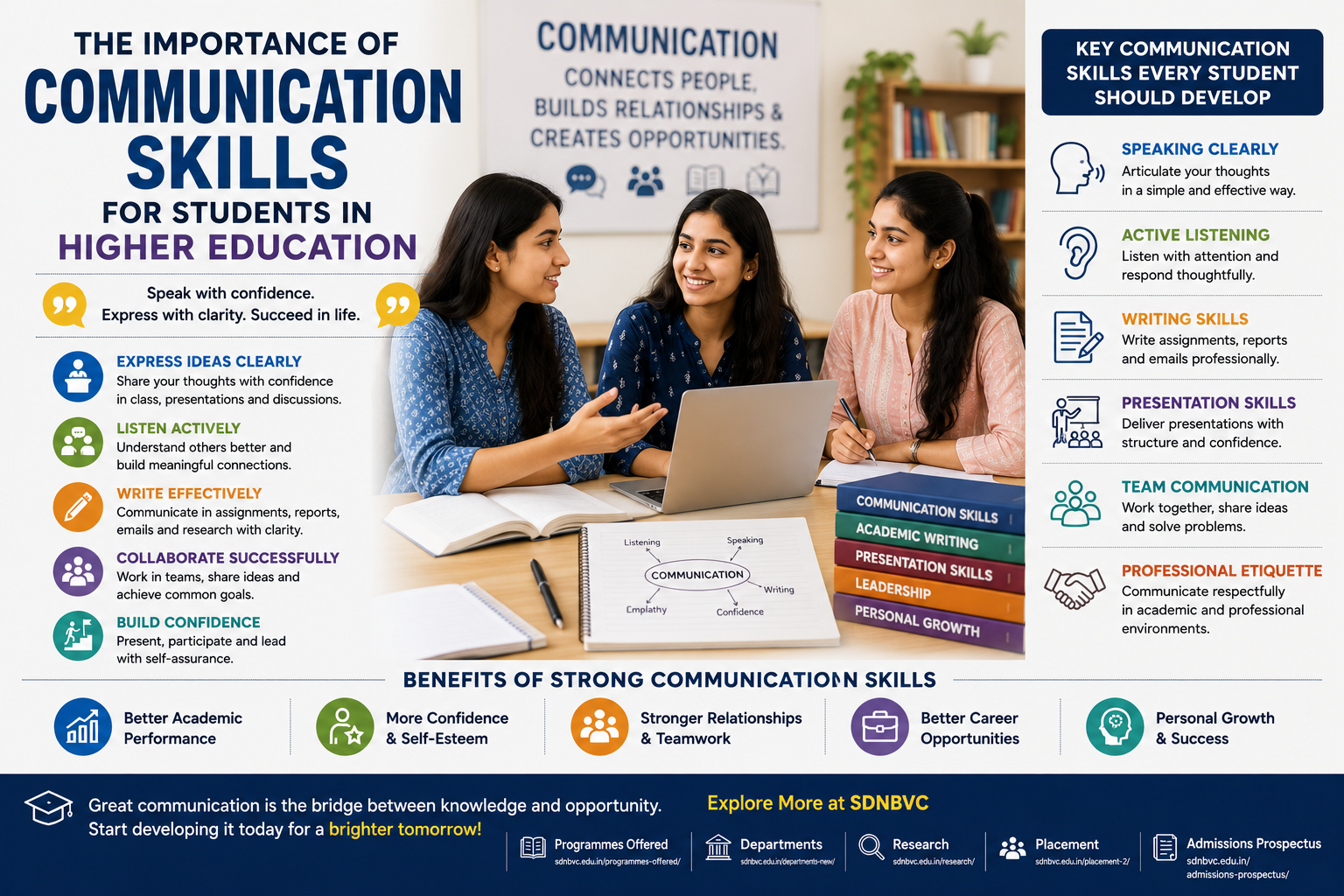
Higher education is not only about learning subjects and writing exams.

It is also about learning how to express ideas, ask questions, present thoughts, work with others and prepare for future opportunities.

This is why communication skills are very important for students in college.

A student may have strong subject knowledge, but if she cannot explain her thoughts clearly, it may affect classroom participation, presentations, interviews, group projects and professional growth.

Good communication helps students become more confident, active and prepared for higher studies, internships, placements, research opportunities and real-world responsibilities.

At SDNB Vaishnav College for Women, Chennai, students can develop communication skills through classroom discussions, department activities, seminars, presentations, projects, workshops, placement preparation and academic participation.

Students can also explore the programmes offered page to understand different academic paths where communication skills support future growth.

What Are Communication Skills?

Communication skills are the abilities that help students share ideas, understand others and respond clearly in different situations.

Communication is not limited to speaking. It also includes listening, writing, reading, body language, presentation ability and professional interaction.

Important communication skills include:

  • Speaking clearly
  • Listening carefully
  • Writing effectively
  • Asking relevant questions
  • Presenting ideas with confidence
  • Participating in discussions
  • Understanding body language
  • Writing emails professionally
  • Explaining thoughts in a simple way
  • Responding respectfully to others

These skills are useful in every stream, including arts, science, commerce, management, computer applications, research and professional courses.

Why Communication Skills Matter in Higher Education

College students interact with teachers, classmates, seniors, department members, guest speakers, interviewers and professionals.

In all these situations, communication plays an important role.

Strong communication skills can help students:

  • Understand subjects better
  • Ask doubts without hesitation
  • Participate in classroom discussions
  • Give better presentations
  • Work well in group projects
  • Perform confidently in interviews
  • Build better relationships with peers and faculty
  • Prepare for internships, placements and higher studies

Students who communicate well are often more confident in academic and professional environments.

Communication Skills vs Subject Knowledge

Subject knowledge is important, but students also need communication skills to use that knowledge effectively.

When students can explain what they know, they become more confident and better prepared for opportunities.

Subject Knowledge Communication Skills
Helps students understand academic concepts Helps students explain those concepts clearly
Important for exams and assignments Important for presentations, interviews and discussions
Builds academic foundation Builds confidence and expression
Shows what a student knows Shows how well a student can share what she knows
Useful for qualification Useful for growth, opportunities and professional success

A successful student should focus on both knowledge and communication.

1. Communication Helps Students Ask Questions

Asking questions is an important part of learning.

Many students hesitate to ask doubts because they fear making mistakes or being judged. But questions help students understand subjects better and clear confusion early.

Good communication helps students ask questions in a clear and respectful way.

Students can improve this habit by:

  • Writing down doubts during class
  • Asking questions after lectures
  • Discussing difficult topics with classmates
  • Approaching faculty for guidance
  • Using simple words to explain confusion

Students who ask questions regularly become more active and confident learners.

2. Communication Improves Classroom Participation

Classroom participation helps students learn beyond textbooks.

When students take part in discussions, they understand different viewpoints and improve their thinking ability.

Communication skills help students participate in:

  • Class discussions
  • Question-and-answer sessions
  • Debates
  • Group learning
  • Seminars
  • Peer discussions

Students do not need to speak perfectly from the beginning. Regular participation helps them improve step by step.

3. Communication Builds Presentation Confidence

Presentations are common in higher education.

Students may need to present assignments, project reports, research topics, seminar papers or group work.

Good communication helps students present ideas clearly and confidently.

Students can improve presentation skills by:

  • Preparing the topic properly
  • Practising before presenting
  • Using simple and clear language
  • Maintaining eye contact
  • Speaking at a steady pace
  • Using examples to explain points
  • Keeping slides simple and readable

Presentation practice also helps students prepare for interviews and professional meetings later.

4. Communication Helps in Group Projects

Group projects require teamwork, coordination and clear discussion.

Students must share responsibilities, discuss ideas, solve problems and complete tasks together.

Good communication helps group members avoid confusion and work smoothly.

In group projects, students should practise:

  • Listening to each team member
  • Sharing ideas clearly
  • Dividing responsibilities fairly
  • Giving updates on time
  • Respecting different opinions
  • Solving disagreements politely

These habits prepare students for future workplace situations where teamwork is very important.

5. Communication Supports Better Writing Skills

Writing is an important part of higher education.

Students need writing skills for assignments, project reports, research summaries, seminar papers, emails, applications and resumes.

Good writing helps students explain ideas in a structured and professional way.

Students can improve writing skills by:

  • Reading regularly
  • Writing short summaries
  • Practising academic writing
  • Checking grammar and sentence clarity
  • Using headings and bullet points where needed
  • Reviewing assignments before submission
  • Learning email writing etiquette

Strong writing skills are useful for both academic success and career readiness.

6. Communication Helps Students Build Confidence

Confidence grows when students practise expressing themselves.

Many students feel nervous while speaking in front of others. This is normal. Confidence improves with small steps and regular practice.

Students can build confidence by:

  • Speaking in small group discussions
  • Answering questions in class
  • Participating in seminars
  • Practising presentations
  • Reading aloud to improve fluency
  • Accepting mistakes as part of learning
  • Taking feedback positively

Confidence in communication helps students become more active in college life.

7. Communication Is Important for Interviews

Interviews are an important part of internships, placements, higher studies and professional opportunities.

During interviews, students need to explain their education, skills, projects, strengths and goals clearly.

Good communication helps students create a positive impression.

Students should practise:

  • Introducing themselves clearly
  • Explaining academic projects
  • Answering questions with confidence
  • Speaking politely and professionally
  • Maintaining positive body language
  • Listening carefully before answering
  • Asking relevant questions when needed

Students who prepare communication skills early feel less nervous during interviews.

8. Communication Builds Better Relationships

College life becomes better when students communicate respectfully with others.

Good communication helps students build healthy relationships with classmates, faculty members, seniors and team members.

Respectful communication includes:

  • Listening without interrupting
  • Speaking politely
  • Understanding different opinions
  • Giving feedback carefully
  • Resolving misunderstandings calmly
  • Showing respect during discussions

These habits are useful not only in college but also in personal and professional life.

9. Communication Helps in Research and Higher Studies

Research and higher studies require strong reading, writing and presentation skills.

Students who want to pursue postgraduate programmes, research, teaching or academic roles should focus on communication from the beginning.

Communication helps students in:

  • Reading academic material
  • Writing research summaries
  • Preparing project reports
  • Presenting research ideas
  • Participating in seminars
  • Discussing topics with faculty
  • Writing applications for higher studies

Students interested in research-based learning can visit the official research page to understand the research environment at SDNB.

10. Communication Improves Career Readiness

Employers often look for students who can communicate clearly and work well with others.

Even when a student has strong technical or academic knowledge, communication skills help her perform better in professional situations.

Career readiness requires communication for:

  • Resume discussions
  • Job interviews
  • Workplace emails
  • Team meetings
  • Client interaction
  • Problem explanation
  • Professional networking

Students who build communication skills during college become better prepared for internships, placements and workplace responsibilities.

Students can also visit the official placement page to understand placement-related support and career opportunities at SDNB.

How Departments Help Improve Communication Skills

Departments provide many opportunities for students to practise communication.

Through academic activities, presentations, seminars, discussions and projects, students learn to express ideas more clearly.

Students can explore academic departments through the official departments page.

Department activities can help students improve:

  • Subject communication
  • Presentation confidence
  • Academic writing
  • Research discussion
  • Team communication
  • Public speaking
  • Leadership communication

Students should actively participate in department activities to build confidence gradually.

Simple Ways Students Can Improve Communication Skills

Communication skills improve with regular practice.

Students can begin with small daily habits instead of waiting for final-year interviews.

Practice Method How It Helps
Reading daily Improves vocabulary, sentence structure and understanding
Writing short summaries Improves clarity and academic writing ability
Speaking in class Builds confidence and expression
Participating in presentations Improves public speaking and preparation
Listening carefully Improves understanding and response quality
Practising email writing Builds professional communication habits

Communication Skills Students Should Practise Before Graduation

Before graduation, students should practise different types of communication that will help them in higher studies and career opportunities.

  • Self-introduction
  • Classroom speaking
  • Presentation delivery
  • Group discussion
  • Academic writing
  • Email writing
  • Interview answers
  • Project explanation
  • Professional conversation
  • Active listening

These skills are useful for students from every academic background.

Common Communication Mistakes Students Should Avoid

Students can improve faster when they understand common mistakes.

Some mistakes to avoid include:

  • Speaking without listening properly
  • Using unclear or incomplete answers
  • Avoiding presentations due to fear
  • Not asking doubts in class
  • Writing emails without proper format
  • Interrupting others during discussions
  • Using casual language in formal situations
  • Not preparing before speaking
  • Ignoring body language
  • Thinking communication improves without practice

Avoiding these mistakes can help students communicate more clearly and confidently.

Before Planning Your Academic Journey: Useful Official Links

Students can explore useful college information through official SDNB pages such as:

These pages can help students understand academic options, department details, research opportunities, placement support and admission-related information before planning their college journey.

Ready to Improve Communication Skills?

Students should start improving communication skills from the first year of college.

Small actions such as reading daily, asking questions, participating in discussions, practising presentations, writing clearly and listening carefully can create strong improvement over time.

Students can also check the programmes offered, explore academic departments, understand research opportunities, visit the placement page, and check the admissions prospectus page for official details.

Good communication helps students become more confident, active and ready for higher studies, internships, placements and future opportunities.

FAQs on Communication Skills for Students

1. Why are communication skills important for college students?

Communication skills help college students express ideas clearly, ask doubts, participate in discussions, give presentations, attend interviews and work well with others.

2. How can students improve communication skills?

Students can improve communication skills by reading regularly, writing summaries, speaking in class, participating in presentations, listening carefully and practising formal communication.

3. Are communication skills useful for higher studies?

Yes. Communication skills are useful for academic writing, research discussions, presentations, interviews, project reports and postgraduate study.

4. Do communication skills help in placements?

Yes. Communication skills help students perform better in interviews, group discussions, resume explanations, workplace conversations and professional interactions.

5. What is the most important communication skill for students?

Clear speaking and active listening are both very important because students need to express their thoughts and also understand others properly.

6. Can shy students improve communication skills?

Yes. Shy students can improve gradually by speaking in small groups, practising presentations, asking questions and participating in classroom activities step by step.

7. Is writing also part of communication skills?

Yes. Writing is an important communication skill. Students need writing skills for assignments, projects, emails, applications, resumes and research work.

Final Thought

Communication skills are essential for students in higher education.

They help students ask questions, participate in class, present ideas, write clearly, work in teams, build confidence and prepare for future opportunities.

Subject knowledge is important, but communication helps students share that knowledge effectively.

At SDNB Vaishnav College for Women, students can use classroom learning, department activities, research exposure, seminars, projects, placement preparation and campus participation to improve communication skills and become more confident in their academic journey.

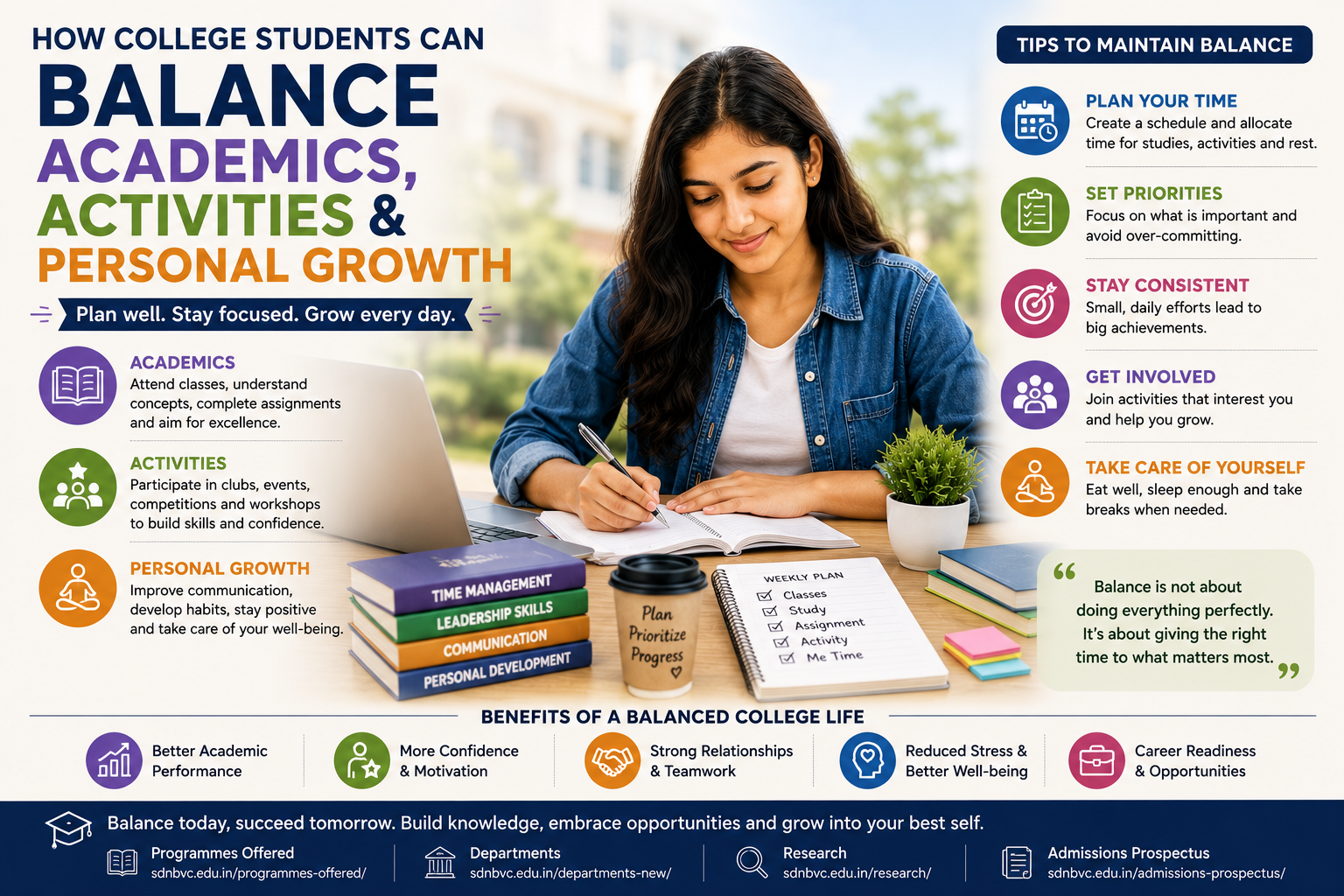
College life is an important stage in every student’s journey.

It is the time when students learn new subjects, meet new people, participate in activities, explore interests and prepare for future opportunities.

However, many students find it difficult to balance academics, college activities and personal growth. Some students focus only on marks. Some become too involved in activities and lose track of studies. Some feel stressed because they try to manage everything without a proper plan.

The right balance helps students enjoy college life while also building a strong academic foundation, useful skills, confidence and future readiness.

At SDNB Vaishnav College for Women, Chennai, students can use their college years to grow academically, socially and personally through classroom learning, department activities, seminars, projects, research exposure and campus participation.

Students can begin by exploring the programmes offered page to understand the academic options available at the college.

Why Balance Matters in College Life

College life is not only about completing a degree.

It is also about becoming independent, responsible, confident and prepared for higher studies or career opportunities.

When students balance academics, activities and personal growth, they can:

  • Perform better in studies
  • Participate in meaningful activities
  • Build confidence and communication skills
  • Develop leadership and teamwork abilities
  • Reduce stress and confusion
  • Prepare for internships and placements
  • Improve time management
  • Enjoy a healthier college experience

A balanced student is not someone who does everything perfectly. A balanced student is someone who knows how to manage priorities wisely.

Academics, Activities and Personal Growth: What Do They Mean?

Before learning how to balance these areas, students should understand what each one includes.

Area What It Includes Why It Matters
Academics Classes, assignments, exams, projects, seminars and subject learning Builds knowledge, discipline and academic foundation
Activities Clubs, competitions, events, workshops, volunteering and department programmes Builds confidence, teamwork, leadership and exposure
Personal Growth Communication, self-confidence, emotional balance, habits, goals and self-awareness Helps students become responsible, independent and future-ready

All three areas are connected. Academics build knowledge, activities build exposure and personal growth builds maturity.

Start by Understanding Your Priorities

The first step to balance is understanding your priorities.

Every student has different goals. Some students want to prepare for higher studies. Some want to build a strong resume for placements. Some want to improve confidence, communication or leadership skills. Some may be preparing for competitive exams or professional courses.

Students should ask themselves:

  • What is my main academic goal this semester?
  • Which subjects need more attention?
  • Which activities will help me grow?
  • How much time can I realistically give to activities?
  • What personal skill do I want to improve?
  • Am I managing my health and rest properly?

Clear priorities help students avoid unnecessary pressure and make better decisions.

Create a Simple Weekly Plan

A weekly plan can help students manage college responsibilities more easily.

Students do not need a complicated timetable. A simple plan is enough if it is practical and followed regularly.

A weekly plan should include time for:

  • Classes and lectures
  • Daily revision
  • Assignments and project work
  • Department activities or events
  • Skill development
  • Reading or research
  • Rest and personal time

Planning the week in advance helps students avoid last-minute stress during exams, submissions and events.

Do Not Ignore Daily Revision

One of the biggest reasons students feel academic pressure is last-minute studying.

Daily revision does not have to take many hours. Even 30 to 45 minutes of focused revision can help students remember concepts better.

Students can revise better by:

  • Reading class notes on the same day
  • Highlighting important points
  • Writing short summaries
  • Clearing doubts early
  • Revising difficult topics weekly
  • Preparing before internal assessments

When students revise regularly, they get more time to participate in activities without affecting academic performance.

Choose Activities That Add Value

College activities are important, but students should choose them wisely.

Participating in every activity may lead to stress. Avoiding all activities may limit growth. The best approach is to select activities that match your interest, skills and goals.

Students can choose activities such as:

  • Department seminars
  • Paper presentations
  • Workshops
  • Competitions
  • Student clubs
  • Cultural events
  • Volunteering
  • Academic discussions
  • Research-based activities

Students can explore academic departments through the official departments page and understand how department-level activities can support their growth.

Learn to Say No When Needed

Balance also means knowing when to say no.

Students may feel pressure to join every activity, attend every event or accept every responsibility. But taking too many commitments can affect studies, health and peace of mind.

Students should say no politely when:

  • Exams or important submissions are near
  • The activity does not match their goals
  • They already have too many responsibilities
  • They are feeling mentally or physically tired
  • The commitment may affect academic performance

Saying no to some things helps students say yes to what matters most.

Use Free Time Productively

Many students lose useful time during breaks, travel or between classes.

Free time does not always need to be used for heavy studying. But small productive actions can make a big difference over time.

Students can use free time to:

  • Review short notes
  • Read a chapter summary
  • Plan assignments
  • Update a resume
  • Read articles or newspapers
  • Practise communication skills
  • Organise study materials
  • Reflect on weekly goals

Using small pockets of time wisely helps students reduce pressure later.

Build Skills Alongside Academics

Academic knowledge is important, but students should also build useful skills during college.

These skills support internships, interviews, higher studies and professional growth.

Students should focus on building:

  • Communication skills
  • Presentation skills
  • Writing skills
  • Digital literacy
  • Teamwork
  • Leadership
  • Problem-solving
  • Time management
  • Confidence

Skill development does not need to happen separately from college life. Students can build skills through assignments, seminars, projects, workshops and group activities.

Keep Personal Growth as a Regular Goal

Personal growth means becoming a better version of yourself.

It includes self-confidence, discipline, emotional balance, communication, positive habits and the ability to handle challenges.

Students can work on personal growth by:

  • Setting small monthly goals
  • Improving one habit at a time
  • Reading regularly
  • Maintaining a positive routine
  • Learning from mistakes
  • Asking for feedback
  • Taking care of physical and mental well-being
  • Staying open to new experiences

Personal growth helps students become more confident in both academic and professional situations.

Manage Stress in a Healthy Way

College students may face stress due to exams, assignments, expectations, competition, personal goals or future planning.

Stress is common, but it should be managed properly.

Students can manage stress by:

  • Planning work early
  • Taking short breaks while studying
  • Sleeping properly
  • Talking to trusted teachers, friends or family
  • Avoiding comparison with others
  • Completing tasks step by step
  • Spending time on hobbies
  • Maintaining a balanced routine

A calm mind helps students learn better and participate more confidently.

Balance Group Work and Individual Study

Both group learning and individual study are useful.

Group work helps students share ideas, improve communication and understand different viewpoints. Individual study helps students focus deeply and understand concepts at their own pace.

Students should use both methods depending on the situation.

Group Work Helps With Individual Study Helps With
Discussions and idea sharing Deep concentration
Group projects and presentations Exam preparation
Communication practice Personal revision
Teamwork and leadership Understanding difficult topics
Peer learning Self-discipline

A smart balance between both methods can improve learning and confidence.

Use Department Guidance and Faculty Support

Students do not have to manage everything alone.

Faculty members and departments can guide students in academics, projects, presentations, research interests, higher studies and career planning.

Students should ask for guidance when they are confused about:

  • Subject difficulty
  • Project topics
  • Research ideas
  • Seminar preparation
  • Course direction
  • Higher study options
  • Skill improvement
  • Career planning

Taking guidance at the right time can help students make better academic and personal decisions.

Explore Research and Academic Curiosity

Research exposure can help students develop deeper thinking.

Students who are interested in academic growth can explore research through reading, projects, surveys, case studies, seminars and presentations.

Research helps students improve:

  • Critical thinking
  • Problem-solving
  • Observation skills
  • Academic writing
  • Subject understanding
  • Independent learning

Students interested in research-based learning can visit the official research page to understand the research environment at SDNB.

Keep Track of Your Growth

Students should regularly track their academic and personal progress.

This helps them understand what is improving and what needs more attention.

Students can track:

  • Marks and internal performance
  • Assignments completed
  • Seminars attended
  • Activities participated in
  • Certificates earned
  • Skills improved
  • Books or articles read
  • Projects completed
  • Personal goals achieved

A simple notebook or digital document can help students maintain this record.

Common Mistakes Students Should Avoid

Students may lose balance when they do not plan properly.

Some common mistakes include:

  • Waiting until the last minute to study
  • Joining too many activities at once
  • Ignoring health and rest
  • Comparing progress with others
  • Not asking for help when needed
  • Spending too much time on distractions
  • Focusing only on marks
  • Avoiding extracurricular activities completely
  • Not maintaining a proper routine
  • Ignoring personal growth

Avoiding these mistakes can help students enjoy college life while staying focused on their goals.

Simple Weekly Balance Checklist for Students

Students can use this checklist to maintain balance every week.

Checklist Point Purpose
Attend classes regularly Build subject understanding
Revise important topics Reduce exam stress
Complete assignments on time Maintain academic discipline
Participate in one meaningful activity Build confidence and exposure
Practise one soft skill Improve personal growth
Take proper rest Maintain health and focus
Review weekly progress Plan better for the next week

Before Planning Your College Journey: Useful Official Links

Students can explore useful college information through official SDNB pages such as:

These pages can help students understand academic options, department details, research opportunities and admission-related information before planning their college journey.

Ready to Balance Academics, Activities and Growth?

Students should begin with small and practical steps.

Start by attending classes regularly, revising daily, choosing meaningful activities, managing time, asking for guidance and setting personal growth goals.

Students can also check the programmes offered, explore academic departments, understand research opportunities, and visit the admissions prospectus page for official details.

A balanced college journey helps students become more confident, capable and prepared for higher studies, internships, placements and future opportunities.

FAQs on Balancing Academics, Activities and Personal Growth

1. How can college students balance studies and activities?

Students can balance studies and activities by planning their week, revising regularly, choosing meaningful activities and avoiding too many commitments at the same time.

2. Are extracurricular activities important in college?

Yes. Extracurricular activities help students build confidence, teamwork, leadership, communication and practical exposure beyond classroom learning.

3. How much time should students spend on personal growth?

Students can spend a small amount of time regularly on personal growth through reading, communication practice, reflection, skill development and healthy habits.

4. Can activities affect academic performance?

Activities may affect academics if students do not manage time properly. But when planned well, activities can improve confidence, discipline and overall student development.

5. Why is time management important for college students?

Time management helps students complete assignments, prepare for exams, participate in activities and reduce last-minute stress.

6. How can students manage stress during college?

Students can manage stress by planning early, taking breaks, sleeping properly, avoiding comparison, talking to trusted people and completing tasks step by step.

7. What is personal growth for students?

Personal growth means improving confidence, communication, discipline, emotional balance, habits, self-awareness and readiness for future responsibilities.

Final Thought

Balancing academics, activities and personal growth is one of the most important parts of college life.

Students should focus on studies, but they should also participate in activities, build skills, manage time and work on personal confidence.

A balanced student is better prepared for higher studies, internships, placements and life after graduation.

At SDNB Vaishnav College for Women, students can use classroom learning, department activities, research exposure and campus opportunities to build a meaningful and confident college journey.

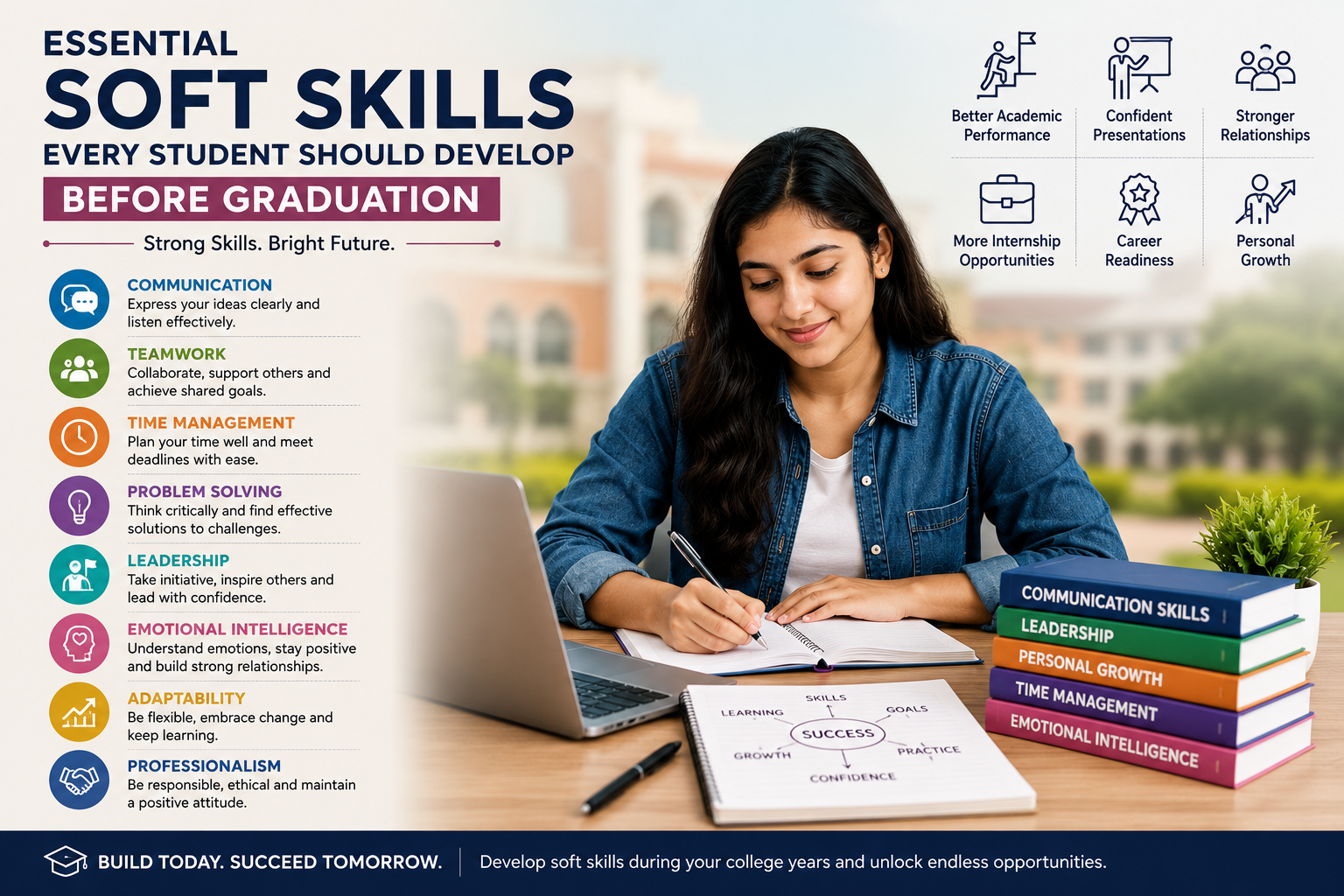
Graduation is not only about completing a degree.

It is also about becoming ready for higher studies, internships, interviews, workplaces, research opportunities and real-life responsibilities.

Many students focus mainly on marks, subjects and exams during college. These are important, but they are not enough by themselves. To succeed after graduation, students also need soft skills.

Soft skills are personal, social and communication-based abilities that help students work with others, solve problems, manage time, express ideas and handle different situations with confidence.

At SDNB Vaishnav College for Women, Chennai, students can use their college years to develop these skills through classroom learning, department activities, seminars, group projects, presentations, academic events and campus participation.

Students can also explore the programmes offered page to understand different academic paths where soft skills can support future growth.

What Are Soft Skills?

Soft skills are non-technical skills that help a student communicate, behave, think and work effectively in academic and professional environments.

They are different from subject knowledge or technical skills. For example, knowing accounting, programming, literature, science or management is academic or technical knowledge. But explaining your ideas clearly, working in a team, managing deadlines and staying confident during interviews are soft skills.

Important soft skills include:

  • Communication skills
  • Teamwork
  • Leadership
  • Time management
  • Problem-solving
  • Adaptability
  • Emotional intelligence
  • Decision-making
  • Confidence
  • Professional behaviour

These skills help students perform better in college and prepare strongly for life after graduation.

Why Soft Skills Matter Before Graduation

Before graduation, students should start preparing for the next stage of life.

Some students may choose higher studies. Some may apply for jobs. Some may prepare for competitive exams, research, entrepreneurship or professional courses. In every path, soft skills are useful.

Soft skills can help students:

  • Perform better in interviews
  • Communicate clearly with teachers, peers and professionals
  • Participate confidently in seminars and presentations
  • Manage academic pressure
  • Work better in group projects
  • Build leadership qualities
  • Adjust to new learning and work environments
  • Improve overall personality and confidence

Students who develop soft skills early often feel more prepared for opportunities after graduation.

Soft Skills vs Technical Skills

Both soft skills and technical skills are important for student success.

Technical skills help students complete subject-related tasks. Soft skills help students use their knowledge effectively in real situations.

Technical Skills Soft Skills
Related to subject knowledge or practical ability Related to behaviour, communication and personality
Can include coding, accounting, lab work, research tools or data handling Can include teamwork, confidence, leadership and communication
Helps students complete academic or job-specific tasks Helps students work with people and handle situations
Usually learned through courses, labs and practical training Developed through practice, interaction and experience
Important for eligibility and role-based work Important for interviews, growth and long-term success

A student with strong subject knowledge and good soft skills can create a better impression in academic and professional settings.

1. Communication Skills

Communication is one of the most important soft skills every student should build before graduation.

Good communication does not only mean speaking in English or using big words. It means expressing ideas clearly, listening carefully, asking relevant questions and presenting thoughts in a respectful way.

Students need communication skills for:

  • Classroom discussions
  • Seminars and presentations
  • Group projects
  • Internship applications
  • Job interviews
  • Email writing
  • Higher study interviews
  • Professional networking

Students can improve communication by participating in presentations, reading regularly, practising writing, speaking in group discussions and asking questions in class.

2. Time Management

Time management helps students complete their work without unnecessary stress.

College life includes classes, assignments, exams, projects, seminars, activities, personal responsibilities and sometimes internships. Without proper time management, students may feel confused or overloaded.

Students can manage time better by:

  • Making a weekly study plan
  • Completing assignments before deadlines
  • Dividing large tasks into smaller steps
  • Avoiding last-minute exam preparation
  • Keeping separate time for revision
  • Reducing distractions while studying
  • Using a notebook, planner or digital calendar

Good time management helps students stay disciplined and improves academic performance.

3. Teamwork

Teamwork is important because students will often need to work with others during college and after graduation.

Group assignments, department events, seminars, competitions, projects and workplace tasks all require teamwork.

A good team member knows how to listen, contribute, respect opinions and complete responsibilities on time.

Teamwork helps students build:

  • Cooperation
  • Patience
  • Responsibility
  • Listening ability
  • Conflict handling
  • Shared decision-making
  • Respect for different viewpoints

Students can develop teamwork by actively participating in department activities, group discussions, student clubs and academic events.

4. Leadership Skills

Leadership does not always mean holding a title or becoming a class representative.

Leadership means taking responsibility, guiding others, solving problems and helping a group move in the right direction.

Students can show leadership by:

  • Taking initiative in group projects
  • Helping classmates understand difficult topics
  • Volunteering for college events
  • Managing small responsibilities during seminars
  • Supporting team members during activities
  • Speaking up with useful ideas

Leadership skills are useful for placements, higher studies, internships and future professional roles.

5. Problem-Solving Ability

Problem-solving is the ability to understand a challenge and find a practical solution.

Students use problem-solving skills in exams, projects, assignments, research work, group activities and daily decision-making.

Problem-solving does not mean having an immediate answer for everything. It means thinking clearly, analysing the situation and choosing the best possible action.

Students can improve problem-solving by:

  • Understanding the root cause of a problem
  • Breaking big problems into smaller parts
  • Discussing ideas with teachers or classmates
  • Reading case studies
  • Working on projects
  • Learning from mistakes
  • Practising logical thinking

This skill is useful in every stream, including arts, science, commerce, management and research.

6. Adaptability

Adaptability means adjusting well to new situations.

Students may face new subjects, new teaching methods, new classmates, digital tools, changing exam patterns, internships or career expectations. Adaptability helps them handle these changes without losing confidence.

Adaptable students are open to learning and improvement.

Students can develop adaptability by:

  • Being open to feedback
  • Trying new learning methods
  • Participating in different activities
  • Learning basic digital tools
  • Staying calm during changes
  • Accepting that mistakes are part of learning

Adaptability is especially important for students preparing for modern careers where skills and expectations keep changing.

7. Emotional Intelligence

Emotional intelligence means understanding your own emotions and responding properly to others.

College students may experience pressure due to exams, assignments, competition, family expectations, career confusion or personal challenges. Emotional intelligence helps students manage these situations in a balanced way.

Emotionally intelligent students can:

  • Stay calm under pressure
  • Understand their strengths and weaknesses
  • Respond instead of reacting quickly
  • Respect other people’s feelings
  • Handle feedback positively
  • Build better relationships

This skill improves confidence, decision-making and personal growth.

8. Confidence

Confidence helps students express themselves without fear.

Many students have good ideas but hesitate to speak because they fear mistakes or judgement. Building confidence during college can make a big difference in interviews, presentations and future opportunities.

Students can build confidence by:

  • Participating in small classroom discussions
  • Practising presentations
  • Preparing well before speaking
  • Accepting mistakes as learning
  • Taking part in competitions or events
  • Improving communication step by step
  • Celebrating small achievements

Confidence grows with regular practice. Students do not need to become perfect speakers immediately.

9. Decision-Making Skills

Decision-making is important because students must make many choices during college.

These choices may include selecting electives, choosing projects, applying for internships, planning higher studies, preparing for placements or deciding career goals.

Good decision-making helps students avoid confusion and pressure.

Students can make better decisions by:

  • Understanding their interests
  • Comparing available options
  • Taking advice from teachers or mentors
  • Checking official information before applying
  • Thinking about long-term goals
  • Avoiding decisions based only on peer pressure

Students can use official pages such as programmes offered and admissions prospectus to make informed academic decisions.

10. Professional Behaviour

Professional behaviour means acting responsibly in academic and work-related situations.

Students should start building professional habits before graduation because these habits are useful during internships, interviews and jobs.

Professional behaviour includes:

  • Being punctual
  • Respecting deadlines
  • Responding politely
  • Dressing appropriately for formal situations
  • Writing clear emails
  • Listening during meetings or lectures
  • Taking responsibility for assigned work
  • Maintaining academic honesty

These habits help students create a positive impression wherever they go.

How Departments Help Students Build Soft Skills

Departments play an important role in student development.

Through academic activities, presentations, seminars, projects and discussions, students get many opportunities to practise soft skills.

Students can explore different academic departments through the official departments page.

Department activities can help students improve:

  • Presentation skills
  • Subject confidence
  • Teamwork
  • Academic writing
  • Research thinking
  • Leadership
  • Peer interaction

Students should actively participate in department-level opportunities instead of only attending regular classes.

The Role of Research in Skill Development

Research is not only for postgraduate students or Ph.D. scholars.

Even undergraduate students can begin developing research-related skills through reading, project work, presentations, surveys, case studies and academic writing.

Research helps students build:

  • Critical thinking
  • Patience
  • Problem-solving
  • Academic writing
  • Observation skills
  • Data interpretation
  • Independent learning

Students interested in research exposure can visit the official research page to understand the research environment at SDNB.

Soft Skills Every Student Should Practise Regularly

Soft skills improve with practice. Students should not wait for final-year placements to begin.

Soft Skill How Students Can Practise It Where It Helps
Communication Presentations, discussions, reading and writing Interviews, seminars and group work
Time Management Study plans, assignment schedules and revision routines Exams, projects and deadlines
Teamwork Group projects, clubs and department events Internships, jobs and academic activities
Leadership Volunteering, organising and taking responsibility Events, interviews and professional growth
Problem-Solving Projects, case studies and logical thinking Research, workplace tasks and decision-making
Adaptability Trying new tools, accepting feedback and learning continuously Higher studies, internships and changing careers

How Students Can Build Soft Skills During College

Students can build soft skills through small but regular actions.

Useful ways to improve soft skills include:

  • Attend seminars and workshops
  • Participate in classroom discussions
  • Volunteer for department activities
  • Take part in group projects
  • Practise public speaking
  • Read books, articles and newspapers
  • Prepare and update a resume
  • Ask for feedback from teachers
  • Join academic or extracurricular activities
  • Reflect on strengths and areas for improvement

Soft skills become stronger when students use them repeatedly in real situations.

Common Mistakes Students Should Avoid

Many students realise the importance of soft skills only during final-year interviews.

Some common mistakes include:

  • Focusing only on marks
  • Avoiding presentations due to fear
  • Not participating in group activities
  • Ignoring communication practice
  • Waiting until final year to prepare for interviews
  • Not asking for feedback
  • Being careless with deadlines
  • Not learning basic email etiquette
  • Avoiding leadership opportunities
  • Not maintaining confidence after mistakes

Avoiding these mistakes can help students become more confident and prepared before graduation.

Before Planning Your Skill Development: Useful Official Links

Students can explore useful college information through official SDNB pages such as:

These pages can help students understand academic options, department details, research opportunities and admission-related information before planning their college journey.

Ready to Develop Soft Skills Before Graduation?

Students should begin developing soft skills from the first year of college.

Small actions such as speaking in class, managing time, joining activities, completing projects, attending workshops and asking for feedback can create strong personal growth before graduation.

Students can also check the programmes offered, explore academic departments, understand research opportunities, and visit the admissions prospectus page for official details.

The earlier students begin, the more confident they become for higher studies, internships, placements and future career opportunities.

FAQs on Soft Skills for Students

1. What are soft skills for students?

Soft skills are personal and communication-based abilities that help students work with others, manage time, solve problems, express ideas and handle academic or professional situations confidently.

2. Why are soft skills important before graduation?

Soft skills are important because they help students prepare for interviews, internships, higher studies, presentations, teamwork, leadership roles and future workplace expectations.

3. Which soft skill should students develop first?

Communication is one of the first soft skills students should develop because it supports classroom learning, presentations, interviews and professional interaction.

4. Can soft skills improve academic performance?

Yes. Skills such as time management, confidence, communication and problem-solving can help students study better, participate actively and complete academic work more effectively.

5. How can students improve soft skills in college?

Students can improve soft skills by participating in seminars, presentations, group projects, department events, workshops, clubs and regular classroom discussions.

6. Are soft skills useful for higher studies?

Yes. Soft skills such as academic writing, communication, research thinking, time management and confidence are useful for postgraduate studies, research and interviews.

7. Do employers value soft skills?

Yes. Employers often look for students who can communicate clearly, work in teams, manage responsibilities, solve problems and adapt to workplace situations.

Final Thought

Soft skills are essential for every student before graduation.

Marks and subject knowledge are important, but students also need communication, confidence, teamwork, time management, leadership, adaptability and problem-solving skills to succeed in the future.

College years are the best time to build these skills step by step.

At SDNB Vaishnav College for Women, students can use academic learning, department activities, research exposure, seminars, projects and campus participation to become more confident, capable and prepared for life after graduation.

College years are not only about attending classes and completing exams.

They are also the most important years for building a strong academic profile that can support your future studies, placements, internships, research opportunities, and career growth.

A good academic profile shows that a student is serious, consistent, skilled, and ready for future opportunities. It is not built in one day. It is developed slowly through regular learning, participation, discipline, projects, communication skills, and smart planning.

For students, especially those beginning their undergraduate or postgraduate journey, college is the right time to build this foundation.

At SDNB Vaishnav College for Women, Chennai, students can use their academic years to develop subject knowledge, confidence, skills, and career readiness through classroom learning, department activities, seminars, projects, workshops, and campus opportunities.

Students can also explore the programmes offered page to understand different academic options available at the college.

What Is an Academic Profile?

An academic profile is a complete picture of a student’s learning journey.

It includes marks, subject knowledge, projects, internships, certifications, research work, presentations, competitions, workshops, extracurricular participation, communication skills, and achievements.

A strong academic profile helps students when they apply for:

  • Higher studies
  • Internships
  • Campus placements
  • Scholarships
  • Research opportunities
  • Competitive exams
  • Professional courses
  • First job opportunities

It shows what a student has learned beyond regular classroom study.

Why a Strong Academic Profile Matters

A strong academic profile helps students stand out.

Many students complete degrees every year. But students who actively build their profile during college have a better chance of being noticed by employers, universities, and professional institutions.

A good academic profile can help you:

  • Improve confidence
  • Build career clarity
  • Prepare for interviews
  • Apply for higher studies
  • Showcase your achievements
  • Develop subject depth
  • Become ready for professional opportunities

College students should not wait until the final year to start building their profile. The process should begin from the first year itself.

Academic Profile vs Academic Marks

Marks are important, but they are only one part of your academic profile.

Your academic profile includes both performance and participation.

Academic Marks Academic Profile
Focuses mainly on exam scores Includes marks, skills, projects, activities and achievements
Shows subject performance Shows overall student development
Important for eligibility Important for opportunities
Measured through exams Built through continuous learning and participation
Limited to academics Includes academic, professional and personal growth

A student with good marks and active participation will usually have a stronger profile than a student who only focuses on exams.

Start With Consistent Academic Performance

The first step to building a strong academic profile is maintaining consistency in studies.

Students do not need to be perfect in every subject, but they should try to understand concepts clearly and avoid last-minute studying.

Consistent academic performance helps students build discipline and confidence.

Students can improve academic performance by:

  • Attending classes regularly
  • Taking clear notes
  • Revising topics weekly
  • Asking questions when concepts are unclear
  • Preparing before internal exams
  • Completing assignments on time
  • Reading beyond textbooks

When students stay consistent from the beginning, they reduce pressure during exams and perform better.

Choose Subjects and Projects Carefully

Projects are an important part of a student’s academic profile.

A good project shows that a student can apply classroom learning to real situations. It also helps during interviews, higher study applications and research discussions.

Students should choose project topics based on:

  • Subject interest
  • Career goals
  • Current industry relevance
  • Research value
  • Practical usefulness
  • Faculty guidance
  • Availability of resources

A project should not be selected only because it is easy. It should help the student learn something meaningful.

Students can discuss project ideas with faculty members and department mentors to choose topics that support their academic and career direction.

Participate in Seminars and Workshops

Seminars and workshops help students learn beyond the syllabus.

They expose students to new ideas, current trends, expert opinions and practical knowledge. Participation also shows that a student is interested in learning and self-improvement.

Students should attend workshops related to:

  • Subject knowledge
  • Research methods
  • Communication skills
  • Digital skills
  • Career planning
  • Interview preparation
  • Entrepreneurship
  • Industry awareness

Even if a workshop seems small, it can add value to your learning and profile.

Certificates from relevant seminars and workshops can also be useful when applying for internships, higher studies or jobs.

Build Communication Skills

Communication skills are very important for every student.

A student may have good subject knowledge, but if she cannot explain her ideas clearly, it may affect interviews, presentations, group discussions and professional growth.

College students should focus on improving:

  • Speaking skills
  • Writing skills
  • Presentation skills
  • Listening skills
  • Group discussion ability
  • Email writing
  • Confidence while expressing ideas

Students can build communication skills by participating in classroom discussions, presentations, debates, seminars and group activities.

Good communication helps students perform better in both academic and career situations.

Take Part in Department Activities

Departments play an important role in shaping a student’s academic journey.

Department activities give students opportunities to learn, participate, present, organise and interact with faculty and peers.

Students can explore academic departments through the official departments page.

Students should take part in:

  • Department seminars
  • Paper presentations
  • Quiz competitions
  • Academic events
  • Guest lectures
  • Subject clubs
  • Group discussions
  • Student presentations

These activities help students build confidence and subject interest.

They also create useful experiences that can be added to a resume or academic portfolio.

Develop Digital and Technical Skills

In today’s career world, digital skills are useful for students from every stream.

Whether a student is from arts, science, commerce, management or any other field, basic digital literacy is important.

Students should learn skills such as:

  • MS Office or Google Workspace
  • Online research
  • Data handling
  • Presentation tools
  • Email communication
  • Basic design tools
  • Digital documentation
  • Internet safety
  • Subject-related software

Students who develop digital skills during college become better prepared for internships, projects, placements and higher studies.

Complete Relevant Certifications

Certifications can strengthen an academic profile when they are chosen wisely.

Students should not collect certificates randomly. Instead, they should choose short courses or certifications that support their subject, career goal or skill gap.

Useful certification areas may include:

  • Communication skills
  • Computer skills
  • Data analysis
  • Finance basics
  • Digital marketing
  • Research writing
  • Programming
  • Entrepreneurship
  • Personality development
  • Industry-specific skills

A certificate is more valuable when the student can actually explain what she learned from it.

Focus on Internships and Practical Exposure

Internships help students understand how classroom learning is used in real work situations.

Even a short internship can give students practical exposure, confidence and career clarity.

Internships can help students learn:

  • Workplace discipline
  • Professional communication
  • Teamwork
  • Problem-solving
  • Time management
  • Industry expectations
  • Practical application of subject knowledge

Students should start exploring internships early, instead of waiting until the final semester.

Internship experience can make a student’s resume stronger and help during job interviews.

Build a Good Resume from the First Year

Many students start preparing their resume only during final-year placements.

This is a mistake.

A resume should be built gradually from the first year of college. Students should keep track of their achievements, certificates, projects, activities and responsibilities.

A student resume can include:

  • Academic details
  • Project work
  • Internships
  • Certifications
  • Seminars attended
  • Workshops completed
  • Department activities
  • Leadership roles
  • Skills
  • Achievements
  • Volunteer experience

Updating the resume regularly saves time and helps students understand where they need improvement.

Develop Research and Writing Skills

Research and writing skills are useful for students who want to pursue higher studies, teaching, research, content-based careers or academic roles.

Students can begin by reading articles, journals, case studies, reports and subject-related materials.

They can also try writing:

  • Short academic notes
  • Project reports
  • Research summaries
  • Presentation content
  • Book reviews
  • Case studies
  • Seminar papers

Research exposure helps students develop analytical thinking, independent learning and subject depth.

Students interested in research-based academic growth can visit the official research page to understand the research environment at SDNB.

Maintain a Record of Achievements

Students should keep a proper record of all academic and extracurricular achievements.

This can include certificates, mark sheets, project reports, internship letters, participation certificates, recommendation letters and published work if any.

A simple digital folder can help students organise everything.

Students can create folders for:

  • Academic documents
  • Certificates
  • Projects
  • Internship records
  • Resume versions
  • Achievement photos
  • Competition details
  • Research work

Having everything organised makes it easier to apply for jobs, higher studies, scholarships and internships.

Build Good Relationships with Faculty

Faculty guidance is very important in building a strong academic profile.

Teachers can help students understand subjects better, choose projects, prepare for presentations, identify strengths and plan future academic or career paths.

Students should feel comfortable asking for guidance when needed.

Faculty members can support students through:

  • Academic advice
  • Project guidance
  • Research direction
  • Career suggestions
  • Recommendation letters
  • Higher study guidance
  • Skill improvement suggestions

A student who actively learns from faculty guidance can make better decisions during college.

Participate in Extracurricular Activities

A strong academic profile is not limited only to marks and classroom learning.

Extracurricular activities help students build leadership, teamwork, confidence, creativity and social awareness.

Students can participate in:

  • Cultural activities
  • Clubs
  • NSS or social service activities
  • Competitions
  • Sports
  • Debates
  • College events
  • Student committees

These activities show that a student is active, responsible and capable of managing different responsibilities.

Employers and institutions often value students who show all-round development.

Common Mistakes Students Should Avoid

Students often miss opportunities because they do not plan early.

Some common mistakes include:

  • Waiting until final year to build a resume
  • Ignoring communication skills
  • Not participating in seminars or workshops
  • Choosing projects without interest
  • Collecting certificates without learning
  • Not maintaining academic documents
  • Avoiding faculty guidance
  • Focusing only on marks
  • Not exploring internships
  • Poor time management

Avoiding these mistakes can help students build a stronger and more useful academic profile.

Before Planning Your Academic Growth: Useful Official Links

Students can explore useful college information through official SDNB pages such as:

These pages can help students understand academic options, department details, research opportunities, admission information and programme-related updates before planning their college journey.

Ready to Build Your Academic Profile?

Students should start building their academic profile from the first year itself.

Small steps taken regularly can create a strong profile by the time students complete their degree.

Start by attending classes regularly, participating in department activities, building skills, completing projects seriously, attending workshops and keeping records of achievements.

Students can also check the programmes offered, explore academic departments, understand research opportunities, and visit the admissions prospectus page for official details.

The earlier students begin, the easier it becomes to prepare for higher studies, placements, internships and career opportunities.

Final Thought

A strong academic profile is built through consistency, participation, learning and self-improvement.

Marks are important, but they are not the only thing that defines a student’s growth.

During college years, students should focus on subject knowledge, communication skills, digital skills, projects, internships, research exposure and extracurricular participation.

At SDNB Vaishnav College for Women, students can use their academic journey to build confidence, improve skills and prepare for a better future.

Arts vs Science vs Commerce: Choosing the Right Stream at SDNB Vaishnav

Choosing the right stream after school is one of the biggest decisions for students. Many students feel confused between Arts, Science and Commerce because each stream offers different subjects, skills, career paths and higher study options.

If you are planning to apply to SDNB Vaishnav College for Women, Chennai, this guide will help you understand the difference between Arts, Science and Commerce programmes in a simple way. It will also help you decide which stream may suit your interests, strengths and future goals.

Quick Answer: Which Stream Should You Choose at SDNB Vaishnav?

Choose Arts if you enjoy language, history, economics, communication, society, writing or people-focused subjects. Choose Science if you are interested in mathematics, computers, data, biology, physics, chemistry, psychology, nutrition or research-based learning. Choose Commerce if you like business, accounting, finance, banking, marketing, management, taxation or entrepreneurship.

Why Choosing the Right Stream Matters

Your stream can shape your college experience, skill development, internships, higher studies and career direction. However, choosing a stream does not mean you are locked into only one type of career forever. Many students build flexible careers by combining their degree with additional skills, certifications, internships and postgraduate studies.

The best stream is not the one others say is “best.” The best stream is the one that matches your interest, learning style and long-term goals.

Streams Available at SDNB Vaishnav College

SDNB Vaishnav College offers a wide range of undergraduate programmes across aided and self-finance categories. These include Arts, Science, Commerce, Computer Applications, Business Administration, Visual Communication, Psychology, Home Science, Travel and Tourism and other career-focused programmes.

Students should check the official programmes page and prospectus before applying, as course availability and admission details may change for each academic year.

Arts Stream at SDNB Vaishnav

The Arts stream is a good choice for students who enjoy understanding people, society, language, culture, history, economics and communication. It is suitable for students who like reading, writing, discussing ideas, analysing social issues or preparing for competitive exams.

Popular Arts-Related Programmes

  • B.A. English
  • B.A. Economics
  • B.A. History and Tourism

Who Should Choose Arts?

You can consider Arts if you:

  • Enjoy reading, writing and communication
  • Are interested in society, history, culture or current affairs
  • Like subjects that involve interpretation and analysis
  • Want to prepare for civil services, teaching, media or public sector exams
  • Prefer theory-based learning with discussion and writing

Career Options After Arts

Arts students can explore different career paths based on their subject and additional skills. Career options may include:

  • Teaching and education
  • Content writing and editing
  • Media and communication
  • Tourism and travel-related roles
  • Public administration
  • Civil services preparation
  • Human resources
  • Research and higher studies
  • Social sector and NGOs

Science Stream at SDNB Vaishnav

The Science stream is suitable for students who are curious about how things work. It is ideal for students who enjoy practical learning, research, experiments, numbers, technology, health sciences or data-based subjects.

Popular Science-Related Programmes

  • B.Sc. Mathematics
  • B.Sc. Statistics
  • B.Sc. Physics
  • B.Sc. Chemistry
  • B.Sc. Plant Biology and Plant Biotechnology
  • B.Sc. Computer Science
  • B.Sc. Computer Science with Artificial Intelligence
  • B.Sc. Computer Science with Data Science
  • B.Sc. Computer Science with Cognitive Systems
  • B.Sc. Visual Communication
  • B.Sc. Psychology
  • B.Sc. Home Science-related programmes
  • B.C.A

Who Should Choose Science?

You can consider Science if you:

  • Enjoy mathematics, computers, lab work or logical thinking
  • Like solving problems step by step
  • Are interested in research, technology, health or data
  • Want to explore careers in IT, analytics, education, research or applied sciences
  • Prefer practical learning along with theory

Career Options After Science

Career options after Science depend on the subject chosen. Students can explore:

  • IT and software-related roles
  • Data analytics
  • Research assistance
  • Teaching and higher education
  • Laboratory and technical roles
  • Nutrition and health-related careers
  • Psychology-related higher studies
  • Media and visual communication roles
  • Postgraduate studies and competitive exams

Commerce Stream at SDNB Vaishnav

The Commerce stream is a good choice for students who are interested in business, finance, accounting, banking, taxation, company law, marketing, entrepreneurship or management. It is also suitable for students who want to pursue professional courses such as CA, CMA, CS, MBA or finance-related certifications.

Popular Commerce and Business-Related Programmes

  • B.Com General
  • B.Com Corporate Secretaryship
  • B.Com Accounting and Finance
  • B.Com Honours
  • B.Com Information System Management
  • B.Com Banking and Insurance Management
  • B.Com Professional Accounting
  • B.Com Computer Application
  • B.Com Fintech and Artificial Intelligence
  • B.Com Banking and Fintech
  • B.Com Investment Banking
  • B.B.A
  • B.B.A Digital Marketing and Business Analytics
  • B.B.A Fashion Management
  • B.B.A Airport and Airline Management

Who Should Choose Commerce?

You can consider Commerce if you:

  • Like business, money management, accounts or finance
  • Are interested in banking, taxation, auditing or corporate roles
  • Want to understand how companies work
  • Are planning for CA, CMA, CS, MBA or finance certifications
  • Enjoy practical subjects connected to real-world business

Career Options After Commerce

Commerce students can build careers in many business and corporate fields. Options may include:

  • Accounting and finance
  • Banking and insurance
  • Taxation and auditing
  • Corporate secretaryship
  • Digital marketing
  • Business analytics
  • Human resources
  • Operations and administration
  • Entrepreneurship
  • MBA and professional courses

Arts vs Science vs Commerce: Simple Comparison

Stream Best For Students Who Like Common Skills Built Possible Career Direction
Arts Language, society, history, economics, communication and culture Writing, analysis, communication, critical thinking and research Teaching, media, civil services, HR, content, tourism and social sector
Science Mathematics, computers, experiments, data, health, biology and technology Logical thinking, problem-solving, technical skills, research and analysis IT, analytics, research, education, health sciences, psychology and higher studies
Commerce Business, accounts, finance, banking, management and entrepreneurship Accounting, business thinking, financial understanding, decision-making and management Finance, banking, auditing, taxation, management, marketing and entrepreneurship

How to Choose the Right Stream: 7 Questions to Ask Yourself

If you are confused, ask yourself these questions before selecting a course:

  1. Which subjects did I enjoy most in school?
  2. Do I prefer theory, practical learning, numbers or business concepts?
  3. Am I comfortable with mathematics or accounts?
  4. Do I want a job soon after UG, or am I planning higher studies?
  5. Which careers sound interesting to me?
  6. Do I enjoy working with people, data, technology, finance or communication?
  7. Can I see myself learning this subject for the next three years?

Your answers can help you understand which stream feels more natural for you.

Choose Arts If…

  • You enjoy reading, writing and communication.
  • You are interested in people, society, history, economics or culture.
  • You want to prepare for teaching, civil services, media or public-facing careers.
  • You like analysing ideas and expressing your opinions clearly.

Choose Science If…

  • You enjoy logical thinking, experiments, technology or data.
  • You are interested in computers, mathematics, biology, chemistry, physics, psychology or nutrition.
  • You want career options in IT, research, analytics, health-related fields or higher studies.
  • You are ready for practical learning and concept-based subjects.

Choose Commerce If…

  • You are interested in accounts, finance, banking, business or management.
  • You want to work in corporate, finance, taxation, marketing or business roles.
  • You are considering CA, CMA, CS, MBA or entrepreneurship.
  • You enjoy practical subjects linked to money, companies and decision-making.

Should You Choose Based on Marks Alone?

Marks are important for admission eligibility, but they should not be the only reason for choosing a stream. A student with good marks in Science may still prefer Commerce because of a strong interest in business. Similarly, a student who enjoys writing and public speaking may be happier in Arts than in a course chosen only because of external pressure.

Choose a stream based on a mix of marks, interest, strengths, career goals and comfort with the subject.

What If You Are Still Confused?

It is completely normal to feel confused. Students can speak to parents, teachers, seniors, admission counsellors or department representatives before making a final choice.

You can also compare the course syllabus, future study options and career paths for each programme. Sometimes, reading the syllabus helps you understand whether the subject is actually right for you.

Tips for Parents Helping Students Choose a Stream

Parents play an important role in helping students make the right decision. Instead of choosing only based on popularity or family expectations, parents can help students understand their interests and long-term goals.

  • Discuss the student’s favourite subjects.
  • Understand their comfort level with numbers, theory or practical work.
  • Compare course options calmly.
  • Avoid forcing a stream only because it seems popular.
  • Encourage the student to think about future careers.
  • Check official admission and eligibility details before applying.

Common Mistakes Students Should Avoid

  • Choosing a stream only because friends selected it
  • Ignoring personal interest
  • Choosing a course without reading the syllabus
  • Assuming one stream is better than all others
  • Not checking eligibility before applying
  • Ignoring future higher study options
  • Waiting until the last minute to decide

Final Checklist Before Choosing a Stream at SDNB Vaishnav

  • Check the official programmes offered page.
  • Read the latest prospectus.
  • Check eligibility criteria for your preferred course.
  • Compare aided and self-finance options.
  • Understand the course syllabus.
  • Think about career and higher study options.
  • Discuss with parents or teachers if needed.
  • Apply through the official admission link.

FAQs on Choosing Arts, Science or Commerce at SDNB Vaishnav

1. Which stream is best at SDNB Vaishnav College?

There is no single best stream for everyone. Arts, Science and Commerce all offer good opportunities. The right choice depends on your interests, strengths, career goals and eligibility.

2. Is Arts a good option for future careers?

Yes. Arts can lead to careers in teaching, media, writing, tourism, public administration, human resources, social sector roles, higher studies and competitive exams.

3. Is Science only for students who want medical or engineering careers?

No. Science also offers opportunities in computer science, data science, research, psychology, nutrition, analytics, teaching and higher education.

4. Is Commerce good for students interested in business?

Yes. Commerce is suitable for students interested in accounting, finance, banking, taxation, business, management, entrepreneurship and professional courses.

5. Can Commerce students choose management-related careers?

Yes. Commerce and business-related programmes can support careers in management, marketing, finance, HR, operations, analytics and entrepreneurship.

6. How do I know which stream is right for me?

Think about your favourite subjects, learning style, career goals, comfort with numbers or theory, and the type of work you want to do in the future.

7. Where can I check the latest SDNB Vaishnav course list?

Students should visit the official SDNB Vaishnav College website, programmes offered page and admission prospectus for the latest course list and eligibility details.

Conclusion

Choosing between Arts, Science and Commerce is an important decision, but it does not have to be stressful. Each stream at SDNB Vaishnav College offers different learning opportunities and career directions.

Arts is a good fit for students who enjoy language, society, culture and communication. Science is suitable for students who like technology, research, data, health sciences and logical thinking. Commerce is ideal for students interested in business, finance, accounts, banking and management.

Before applying, students should check the official course list, read the prospectus, understand eligibility and choose a stream that matches their interests and future goals.

Ready to Choose Your Stream?

Visit the official SDNB Vaishnav College programmes and admissions pages to explore available courses, check eligibility and apply for the stream that suits you best.