
Higher education is not only about learning subjects and writing exams.
It is also about learning how to express ideas, ask questions, present thoughts, work with others and prepare for future opportunities.
This is why communication skills are very important for students in college.
A student may have strong subject knowledge, but if she cannot explain her thoughts clearly, it may affect classroom participation, presentations, interviews, group projects and professional growth.
Good communication helps students become more confident, active and prepared for higher studies, internships, placements, research opportunities and real-world responsibilities.
At SDNB Vaishnav College for Women, Chennai, students can develop communication skills through classroom discussions, department activities, seminars, presentations, projects, workshops, placement preparation and academic participation.
Students can also explore the programmes offered page to understand different academic paths where communication skills support future growth.
What Are Communication Skills?
Communication skills are the abilities that help students share ideas, understand others and respond clearly in different situations.
Communication is not limited to speaking. It also includes listening, writing, reading, body language, presentation ability and professional interaction.
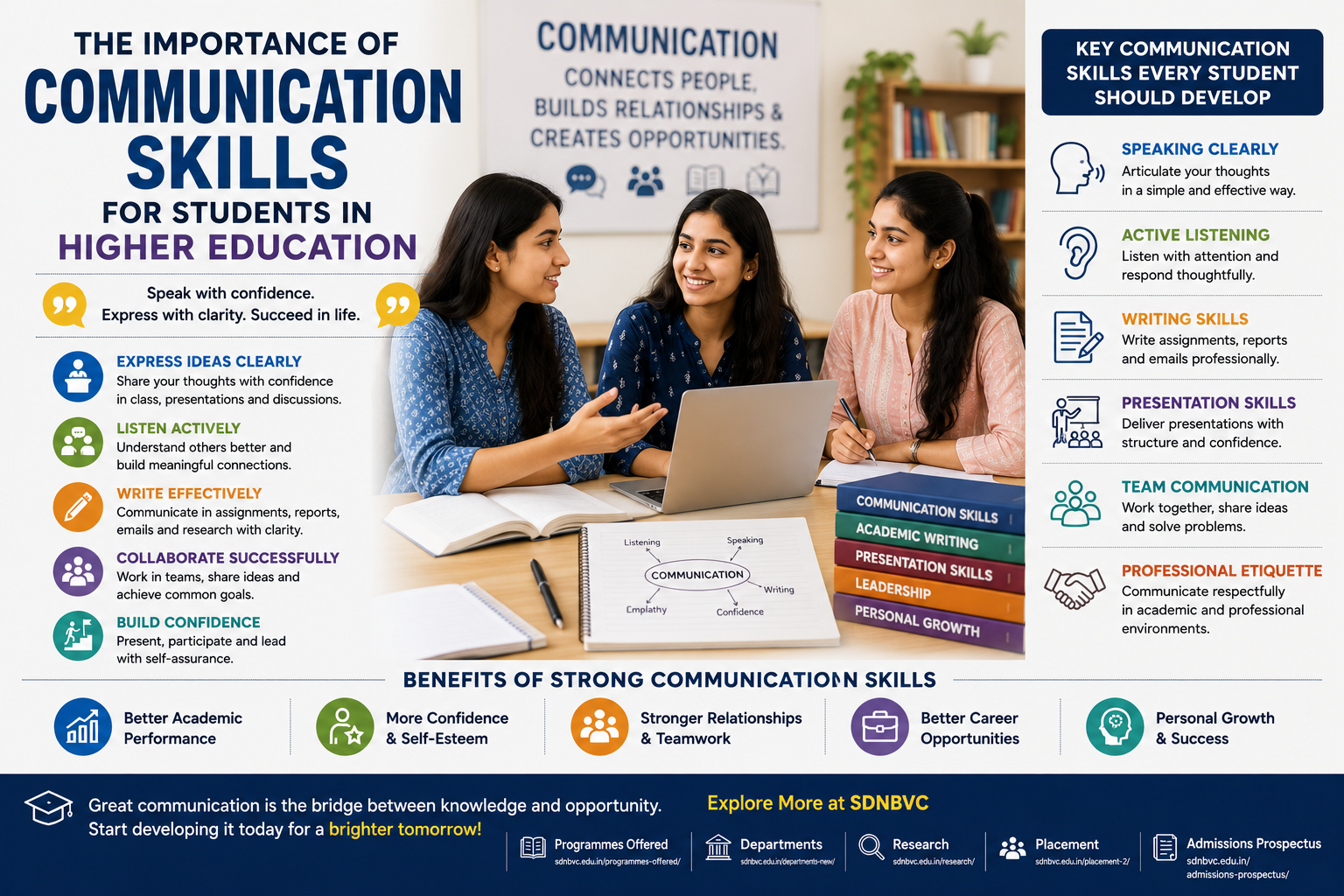
Important communication skills include:
- Speaking clearly
- Listening carefully
- Writing effectively
- Asking relevant questions
- Presenting ideas with confidence
- Participating in discussions
- Understanding body language
- Writing emails professionally
- Explaining thoughts in a simple way
- Responding respectfully to others
These skills are useful in every stream, including arts, science, commerce, management, computer applications, research and professional courses.
Why Communication Skills Matter in Higher Education
College students interact with teachers, classmates, seniors, department members, guest speakers, interviewers and professionals.
In all these situations, communication plays an important role.
Strong communication skills can help students:
- Understand subjects better
- Ask doubts without hesitation
- Participate in classroom discussions
- Give better presentations
- Work well in group projects
- Perform confidently in interviews
- Build better relationships with peers and faculty
- Prepare for internships, placements and higher studies
Students who communicate well are often more confident in academic and professional environments.
Communication Skills vs Subject Knowledge
Subject knowledge is important, but students also need communication skills to use that knowledge effectively.
When students can explain what they know, they become more confident and better prepared for opportunities.
| Subject Knowledge | Communication Skills |
|---|---|
| Helps students understand academic concepts | Helps students explain those concepts clearly |
| Important for exams and assignments | Important for presentations, interviews and discussions |
| Builds academic foundation | Builds confidence and expression |
| Shows what a student knows | Shows how well a student can share what she knows |
| Useful for qualification | Useful for growth, opportunities and professional success |
A successful student should focus on both knowledge and communication.
1. Communication Helps Students Ask Questions
Asking questions is an important part of learning.
Many students hesitate to ask doubts because they fear making mistakes or being judged. But questions help students understand subjects better and clear confusion early.
Good communication helps students ask questions in a clear and respectful way.
Students can improve this habit by:
- Writing down doubts during class
- Asking questions after lectures
- Discussing difficult topics with classmates
- Approaching faculty for guidance
- Using simple words to explain confusion
Students who ask questions regularly become more active and confident learners.
2. Communication Improves Classroom Participation
Classroom participation helps students learn beyond textbooks.
When students take part in discussions, they understand different viewpoints and improve their thinking ability.
Communication skills help students participate in:
- Class discussions
- Question-and-answer sessions
- Debates
- Group learning
- Seminars
- Peer discussions
Students do not need to speak perfectly from the beginning. Regular participation helps them improve step by step.
3. Communication Builds Presentation Confidence
Presentations are common in higher education.
Students may need to present assignments, project reports, research topics, seminar papers or group work.
Good communication helps students present ideas clearly and confidently.
Students can improve presentation skills by:
- Preparing the topic properly
- Practising before presenting
- Using simple and clear language
- Maintaining eye contact
- Speaking at a steady pace
- Using examples to explain points
- Keeping slides simple and readable
Presentation practice also helps students prepare for interviews and professional meetings later.
4. Communication Helps in Group Projects
Group projects require teamwork, coordination and clear discussion.
Students must share responsibilities, discuss ideas, solve problems and complete tasks together.
Good communication helps group members avoid confusion and work smoothly.
In group projects, students should practise:
- Listening to each team member
- Sharing ideas clearly
- Dividing responsibilities fairly
- Giving updates on time
- Respecting different opinions
- Solving disagreements politely
These habits prepare students for future workplace situations where teamwork is very important.
5. Communication Supports Better Writing Skills
Writing is an important part of higher education.
Students need writing skills for assignments, project reports, research summaries, seminar papers, emails, applications and resumes.
Good writing helps students explain ideas in a structured and professional way.
Students can improve writing skills by:
- Reading regularly
- Writing short summaries
- Practising academic writing
- Checking grammar and sentence clarity
- Using headings and bullet points where needed
- Reviewing assignments before submission
- Learning email writing etiquette
Strong writing skills are useful for both academic success and career readiness.
6. Communication Helps Students Build Confidence
Confidence grows when students practise expressing themselves.
Many students feel nervous while speaking in front of others. This is normal. Confidence improves with small steps and regular practice.
Students can build confidence by:
- Speaking in small group discussions
- Answering questions in class
- Participating in seminars
- Practising presentations
- Reading aloud to improve fluency
- Accepting mistakes as part of learning
- Taking feedback positively
Confidence in communication helps students become more active in college life.
7. Communication Is Important for Interviews
Interviews are an important part of internships, placements, higher studies and professional opportunities.
During interviews, students need to explain their education, skills, projects, strengths and goals clearly.
Good communication helps students create a positive impression.
Students should practise:
- Introducing themselves clearly
- Explaining academic projects
- Answering questions with confidence
- Speaking politely and professionally
- Maintaining positive body language
- Listening carefully before answering
- Asking relevant questions when needed
Students who prepare communication skills early feel less nervous during interviews.
8. Communication Builds Better Relationships
College life becomes better when students communicate respectfully with others.
Good communication helps students build healthy relationships with classmates, faculty members, seniors and team members.
Respectful communication includes:
- Listening without interrupting
- Speaking politely
- Understanding different opinions
- Giving feedback carefully
- Resolving misunderstandings calmly
- Showing respect during discussions
These habits are useful not only in college but also in personal and professional life.
9. Communication Helps in Research and Higher Studies
Research and higher studies require strong reading, writing and presentation skills.
Students who want to pursue postgraduate programmes, research, teaching or academic roles should focus on communication from the beginning.
Communication helps students in:
- Reading academic material
- Writing research summaries
- Preparing project reports
- Presenting research ideas
- Participating in seminars
- Discussing topics with faculty
- Writing applications for higher studies
Students interested in research-based learning can visit the official research page to understand the research environment at SDNB.
10. Communication Improves Career Readiness
Employers often look for students who can communicate clearly and work well with others.
Even when a student has strong technical or academic knowledge, communication skills help her perform better in professional situations.
Career readiness requires communication for:
- Resume discussions
- Job interviews
- Workplace emails
- Team meetings
- Client interaction
- Problem explanation
- Professional networking
Students who build communication skills during college become better prepared for internships, placements and workplace responsibilities.
Students can also visit the official placement page to understand placement-related support and career opportunities at SDNB.
How Departments Help Improve Communication Skills
Departments provide many opportunities for students to practise communication.
Through academic activities, presentations, seminars, discussions and projects, students learn to express ideas more clearly.
Students can explore academic departments through the official departments page.
Department activities can help students improve:
- Subject communication
- Presentation confidence
- Academic writing
- Research discussion
- Team communication
- Public speaking
- Leadership communication
Students should actively participate in department activities to build confidence gradually.
Simple Ways Students Can Improve Communication Skills
Communication skills improve with regular practice.
Students can begin with small daily habits instead of waiting for final-year interviews.
| Practice Method | How It Helps |
|---|---|
| Reading daily | Improves vocabulary, sentence structure and understanding |
| Writing short summaries | Improves clarity and academic writing ability |
| Speaking in class | Builds confidence and expression |
| Participating in presentations | Improves public speaking and preparation |
| Listening carefully | Improves understanding and response quality |
| Practising email writing | Builds professional communication habits |
Communication Skills Students Should Practise Before Graduation
Before graduation, students should practise different types of communication that will help them in higher studies and career opportunities.
- Self-introduction
- Classroom speaking
- Presentation delivery
- Group discussion
- Academic writing
- Email writing
- Interview answers
- Project explanation
- Professional conversation
- Active listening
These skills are useful for students from every academic background.
Common Communication Mistakes Students Should Avoid
Students can improve faster when they understand common mistakes.
Some mistakes to avoid include:
- Speaking without listening properly
- Using unclear or incomplete answers
- Avoiding presentations due to fear
- Not asking doubts in class
- Writing emails without proper format
- Interrupting others during discussions
- Using casual language in formal situations
- Not preparing before speaking
- Ignoring body language
- Thinking communication improves without practice
Avoiding these mistakes can help students communicate more clearly and confidently.
Before Planning Your Academic Journey: Useful Official Links
Students can explore useful college information through official SDNB pages such as:
These pages can help students understand academic options, department details, research opportunities, placement support and admission-related information before planning their college journey.
Ready to Improve Communication Skills?
Students should start improving communication skills from the first year of college.
Small actions such as reading daily, asking questions, participating in discussions, practising presentations, writing clearly and listening carefully can create strong improvement over time.
Students can also check the programmes offered, explore academic departments, understand research opportunities, visit the placement page, and check the admissions prospectus page for official details.
Good communication helps students become more confident, active and ready for higher studies, internships, placements and future opportunities.
FAQs on Communication Skills for Students
1. Why are communication skills important for college students?
Communication skills help college students express ideas clearly, ask doubts, participate in discussions, give presentations, attend interviews and work well with others.
2. How can students improve communication skills?
Students can improve communication skills by reading regularly, writing summaries, speaking in class, participating in presentations, listening carefully and practising formal communication.
3. Are communication skills useful for higher studies?
Yes. Communication skills are useful for academic writing, research discussions, presentations, interviews, project reports and postgraduate study.
4. Do communication skills help in placements?
Yes. Communication skills help students perform better in interviews, group discussions, resume explanations, workplace conversations and professional interactions.
5. What is the most important communication skill for students?
Clear speaking and active listening are both very important because students need to express their thoughts and also understand others properly.
6. Can shy students improve communication skills?
Yes. Shy students can improve gradually by speaking in small groups, practising presentations, asking questions and participating in classroom activities step by step.
7. Is writing also part of communication skills?
Yes. Writing is an important communication skill. Students need writing skills for assignments, projects, emails, applications, resumes and research work.
Final Thought
Communication skills are essential for students in higher education.
They help students ask questions, participate in class, present ideas, write clearly, work in teams, build confidence and prepare for future opportunities.
Subject knowledge is important, but communication helps students share that knowledge effectively.
At SDNB Vaishnav College for Women, students can use classroom learning, department activities, research exposure, seminars, projects, placement preparation and campus participation to improve communication skills and become more confident in their academic journey.